
Global Energy & Strategic Industrial (G-ESI)
Is Energy Investment Shifting From Nuclear to Hydrogen?
Energy investment is expanding into low-carbon hydrogen, but that does not establish a broad shift away from nuclear power. The two technologies sell different products and often draw on different sources of capital. Nuclear projects supply electricity and, in suitable configurations, heat. Hydrogen projects convert energy into a fuel or industrial feedstock whose value depends on production costs, transport, emissions performance, and contracted demand.
A genuine investment shift requires evidence that capital previously available to nuclear is being redirected into hydrogen within comparable portfolios. Announced hydrogen capacity alone cannot demonstrate that movement. Hydrogen investment can grow alongside nuclear investment, and nuclear electricity can support hydrogen production. The useful comparison is where each technology reaches a financeable project, what revenue supports it, and which constraints prevent committed capital from becoming operating assets.
Investment announcements do not establish capital substitution
A proposed hydrogen hub and a nuclear plant under construction represent very different levels of financial commitment. Early development budgets cover feasibility studies, permitting, site options, and commercial negotiations. A final investment decision generally signals a stronger commitment, although its significance still depends on financing conditions and outstanding approvals. Construction spending and operating assets provide firmer evidence of deployment.
This distinction matters because large announcements can include multiple phases, conditional expansion, or infrastructure shared across several prospective projects. Adding their full proposed values to an investment total can overstate the capital actually committed. Nuclear figures present a separate problem: expenditure on lifetime extensions, replacement components, and new reactors can be grouped together despite different construction risks and revenue timelines.
A defensible comparison follows both technologies through equivalent stages: development spending, committed financing, construction expenditure, and commissioned capacity. It also separates public support from private capital and distinguishes project financing from corporate acquisitions. Buying shares in an existing asset changes ownership; it does not necessarily fund additional energy supply.
Even comparable investment totals need a portfolio boundary. A utility reducing planned reactor expenditure while financing electrolyzers provides evidence of substitution within that utility. A fertilizer producer funding hydrogen production while an unrelated electricity generator extends a reactor’s life describes two separate investment decisions.
Nuclear and hydrogen earn their returns differently
Nuclear power produces electricity that can be sold through wholesale markets, long-term contracts, or regulated arrangements. Its financial performance depends heavily on construction cost, financing terms, operating availability, and the price received for output. Existing reactors and new construction deserve separate treatment: an operating plant with an established maintenance record has a different risk profile from a first project using an unfamiliar design.
Hydrogen production has an additional commercial dependency. It purchases or consumes energy to manufacture a product that must meet a customer’s specification at an agreed delivery point. Electricity cost matters for electrolysis, while gas cost and carbon management matter for hydrogen made from natural gas with carbon capture. Neither route becomes commercially secure merely because production equipment works.
These differences explain why an apparently smaller hydrogen project does not automatically offer lower overall investment risk. Its production unit can be technically straightforward while its power contract, pipeline connection, and customer conversion remain unresolved. Conversely, a nuclear project with predictable revenue can still face substantial exposure to construction delays.
Hydrogen economics turn on delivered cost and utilization
For electrolytic hydrogen, electricity is both an operating expense and a determinant of equipment utilization. Buying only during low-price hours reduces the average electricity purchase price, but spreads capital recovery over fewer kilograms of hydrogen. Running more hours increases output while exposing the project to additional electricity costs. The economically attractive operating schedule must account for both effects.
Equipment comparisons therefore need a consistent system boundary. Stack efficiency excludes some loads that appear in a complete facility, including water treatment, cooling, power conversion, and compression. A hydrogen cost estimate measured at the electrolyzer outlet cannot be compared directly with a delivered price that includes storage and transport.
Delivery requirements can change the preferred project configuration. A nearby industrial customer using gaseous hydrogen through a dedicated connection avoids some conversion and logistics costs. Shipping hydrogen through an intermediate product introduces additional processing, handling, and potentially reconversion. Those steps require capital and consume energy, even when they solve a transport problem.
For gas-based hydrogen with carbon capture, the relevant questions include capture coverage across the facility, upstream methane emissions, and the availability of verified carbon dioxide transport and storage. A capture percentage for one process stream does not describe the emissions intensity of the entire hydrogen supply chain.
Hydrogen investment becomes more credible when production, infrastructure, and consumption are commercially aligned. An offtake agreement must establish volume, delivery conditions, pricing, and the treatment of interruptions. A preliminary expression of interest leaves demand risk largely with the project.
Nuclear financing separates operating assets from new builds
Investment in an existing reactor often concerns maintaining or extending an established source of electricity. The assessment turns on component condition, required upgrades, outage duration, licensing outcomes, and expected future revenue. Comparing this expenditure with a new hydrogen facility as though both were competing new technologies obscures the actual choice.
New nuclear construction concentrates expenditure before electricity sales begin. Delays increase financing costs and postpone revenue, so the allocation of construction and schedule risk strongly influences the cost of capital. A fixed-price contract offers limited protection if exclusions are broad or the contractor lacks the financial capacity to absorb overruns.
Smaller reactor designs change project scale and construction strategy, but smaller unit size alone does not establish competitive electricity costs. Repeat manufacturing, design stability, licensing progress, and an executable order pipeline must support the proposed economics. Factory production benefits remain assumptions until the necessary production system and orders exist.
For capital allocation, the relevant question is whether a particular nuclear project has a credible route through construction and revenue recovery. A comparison based only on technology labels misses the difference between a proven operating asset, a repeat build, and an early commercial design.
Policy changes the investment case through specific mechanisms
Public support affects nuclear and hydrogen through different channels. Construction financing, revenue stabilization, and mechanisms that reduce borrowing costs address major nuclear exposures. Hydrogen production incentives and demand obligations address the gap between production cost and the price customers are prepared to pay. The value of either arrangement depends on eligibility, duration, enforceability, and the allocation of compliance risk.
For hydrogen, emissions accounting can determine whether the product qualifies for support or satisfies a customer’s purchasing requirements. Rules governing electricity sourcing, the timing of generation, and geographic matching influence operating schedules and power procurement. A low average grid emissions figure does not automatically establish compliance under every accounting framework.
Nuclear-powered electrolysis illustrates the importance of this distinction. Hydrogen produced using nuclear electricity can have low lifecycle emissions, while eligibility under a renewable-specific support scheme is a separate question. Project models need to distinguish physical emissions performance from the precise legal definition governing financial support.
Policy also changes demand quality. A requirement to consume qualifying hydrogen creates a different commercial foundation from a voluntary ambition. However, a policy target alone does not identify the counterparty that will sign a purchase agreement, its creditworthiness, or the price it will accept.
Where nuclear and hydrogen reinforce each other
Nuclear electricity can supply electrolyzers where the power price, connection arrangement, and hydrogen demand support the combination. A relatively steady electricity supply supports higher electrolyzer utilization, which spreads equipment costs across greater output. That advantage must be weighed against the revenue the nuclear plant could earn by selling electricity elsewhere.
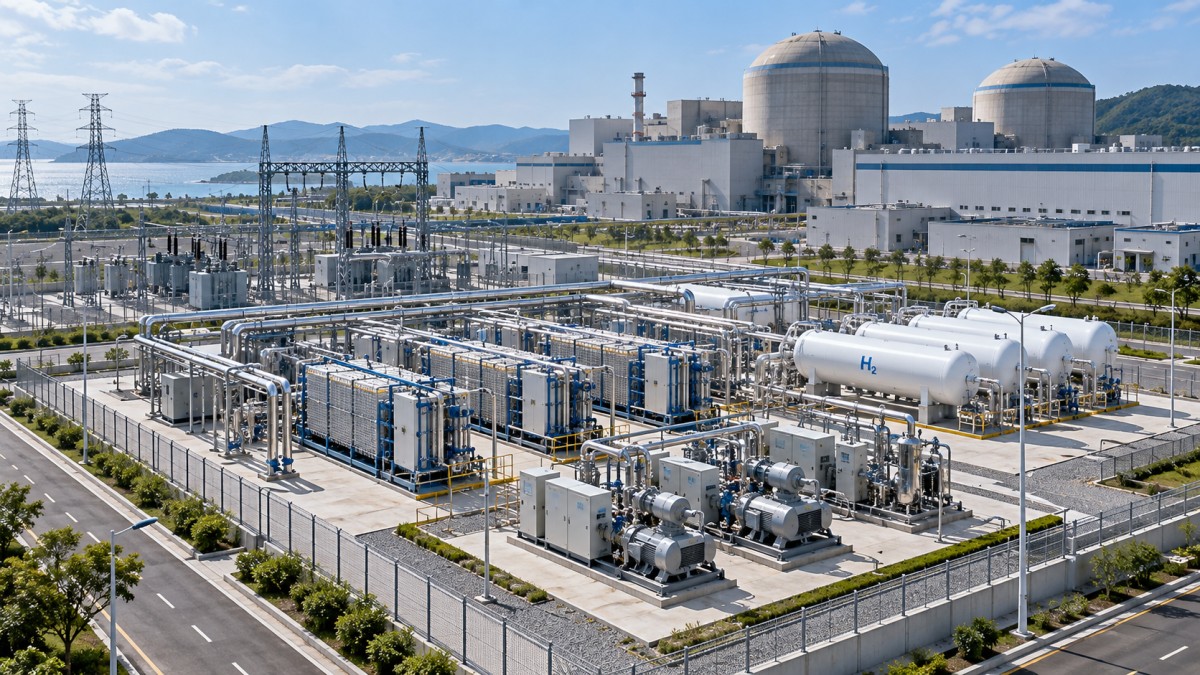
The combined project therefore has an opportunity cost. If electricity prices rise, hydrogen production must justify diverting power from the grid. Flexible operation creates choices, but it also introduces requirements for hydrogen storage and delivery management. A customer expecting continuous supply cannot rely solely on production during favorable electricity-price periods without a buffer or alternative supply.
Physical proximity can simplify the arrangement, particularly where an industrial site already consumes hydrogen. Yet shared location does not eliminate engineering boundaries. Electrical connections, water supply, hazardous-area separation, maintenance access, and licensing interfaces still require coordination. A hydrogen facility’s operating requirements must remain compatible with the nuclear plant’s safety and operating constraints.
Heat integration offers another potential connection. High-temperature electrolysis uses heat as well as electricity, but the benefit depends on compatible temperatures and a workable interface. Heat extraction, equipment availability, and operational coupling need evaluation before any efficiency advantage is treated as a bankable return.
What would demonstrate a real shift in future energy portfolios?
The strongest evidence would combine declining nuclear commitments with increasing hydrogen commitments inside the same defined investment pool. That comparison needs consistent treatment of project stage, ownership share, financing source, and expenditure period. It should also distinguish a temporary pause caused by permitting or construction sequencing from a deliberate change in long-term allocation.
Several observable developments would strengthen the case for hydrogen attracting a larger allocation: binding demand at prices that cover delivered costs, infrastructure reaching construction alongside production facilities, and financing that does not rely on unresolved support assumptions. Nuclear’s relative position improves where construction execution becomes more predictable or existing plants secure economically justified operating extensions.
Some capital will compete directly between the two. A corporate balance sheet has limited borrowing capacity, and public budgets face competing commitments. Other funding has narrower mandates: infrastructure capital seeking contracted operating revenue, development capital accepting early project uncertainty, and strategic industrial investment securing feedstock supply are pursuing different exposures.
Without matched evidence on actual commitments, the defensible conclusion is that hydrogen adds an investment category rather than proving a wholesale departure from nuclear. The decisive signal is the point at which projects secure finance, enter construction, and earn revenue under workable operating conditions. Where nuclear supplies competitive electricity to contracted hydrogen production, rising investment in one can directly support investment in the other.
Related Industries
- What Should You Check When Buying Rice Milling Machines Wholesale?Buying rice milling machines wholesale? Learn how to verify capacity, rice recovery, operating costs, and supplier support to avoid costly mistakes and buy with confidence.
- Oct. 28 Rare Earth Magnet Index Eases as Pr-Nd Oxide Softens, Dysprosium Oxide RisesRare Earth Magnet Index fell 0.24% on Oct. 28, 2026, as Pr-Nd oxide softened and dysprosium oxide rose. Explore what diverging prices mean for magnet procurement and supplier quotes.
- Which Safety Standards Apply to Autonomous Harvesters in the Field?Explore autonomous harvester safety standards, including ISO 18497, ISO 25119, and ISO 4254. Learn what evidence to demand before approving safe field operations.
Weekly Insights
Stay ahead with our curated technology reports delivered every Monday.
Related Industries
Recommended News
- 00
0000-00
European Commission Opens Consultation on Updated EU Hydrogen StrategyEU hydrogen strategy consultation puts deployment challenges and next-generation electrolysers and fuel cells in focus. Explore what the review could mean for developers and industry stakeholders.By Dr. Julian VoltOct 27, 2026 - 00
0000-00
Is Energy Investment Shifting From Nuclear to Hydrogen?Is investment shifting from nuclear to hydrogen in future energy portfolios? Explore costs, financing, and demand to discover whether hydrogen complements or replaces nuclear.By Dr. Julian VoltOct 26, 2026 - 00
0000-00
How Do Gas-Cooled Reactor Temperatures Affect Thermal Efficiency?Explore nuclear reactor thermal efficiency in gas cooled reactor designs. Discover how temperature, materials, and power cycles affect net output—and compare performance with confidence.By Dr. Julian VoltOct 18, 2026
0000-00