
Global Energy & Strategic Industrial (G-ESI)
How to verify material traceability with aerospace steel suppliers
A shipment of aerospace steel arrives with a certificate, but the bar markings show a different identifier from the mill report. Receiving cannot establish whether the difference is a legitimate distributor reference or a material mix-up. Releasing the shipment could introduce unverified stock into production; holding it could delay machining and increase costs.
To verify material traceability with aerospace steel suppliers, establish an unbroken, documented link between the delivered material, its original heat, subsequent processing lots, and the test results required by the purchase order. Check physical identification against original-source records, reconcile every identifier change, and resolve discrepancies before release. A certificate of conformity alone does not establish this chain.
Define the acceptance basis before requesting certificates
Traceability review starts with the purchase order, drawing, and applicable material specification—not with whatever paperwork the supplier normally provides. Without a defined acceptance basis, a complete-looking document pack may still describe the wrong product form, condition, or testing scope.
Record the exact alloy designation, material specification and required revision, dimensions, delivery condition, and any customer-specific requirements. Confirm the permitted revision basis rather than assuming the newest revision automatically applies. Requirements for approved sources, melting route, heat treatment, inspection, or country of origin should be explicit where applicable.
Separate material identity from material compliance. A continuous record may prove where a bar came from while also showing that its condition is unsuitable. Conversely, chemical results that match an alloy do not establish that the tested sample represents the delivered stock.
- Identity: Which heat and relevant processing lot produced this material?
- Compliance: Do the documented processes and results satisfy the ordered requirements?
- Continuity: How was identity preserved through distribution, cutting, processing, and shipment?
These are separate release questions. A favorable answer to one cannot compensate for missing evidence on another.
Request a traceability pack that follows the material
Ask for the original mill test report, often called an MTR or material test certificate, plus records covering any subsequent operations relevant to acceptance. A distributor-issued certificate can connect the shipment to the underlying records, but it should not replace required mill or processor evidence.
Not every order requires every record. The package should reflect the specification, customer requirements, and processing route. For example, stock supplied after additional heat treatment needs evidence connecting that treatment to the delivered lot; the original mill report may describe an earlier condition.
Reconcile the delivered stock with the documentary chain
Start at receiving, not at the certificate header
Compare the actual shipment with the packing list and purchase order. Check product form, dimensions, quantity, delivery condition where identifiable, and visible markings. Photograph labels and markings before packaging is discarded or stock is divided. Keep material segregated until its acceptance status is established.
Read identifiers exactly, including prefixes, suffixes, and separators. Similar-looking heat numbers are not evidence of equivalence. A supplier may legitimately use an internal stock code, but the receiving record must show how that code maps to the mill heat and any relevant processing lot.
Trace backward through each change of identifier
Follow the delivered-piece or bundle reference to the distributor record, then to processing records and the mill report. A single mill heat can be divided into several processing lots. Heat identity therefore may not be enough to establish which heat-treatment cycle or test lot applies.
For material produced through a remelting route, confirm that the records preserve the relationship between relevant melt identifiers as required by the specification. Do not infer the melting route from an alloy name or the word “aerospace” on a quotation.
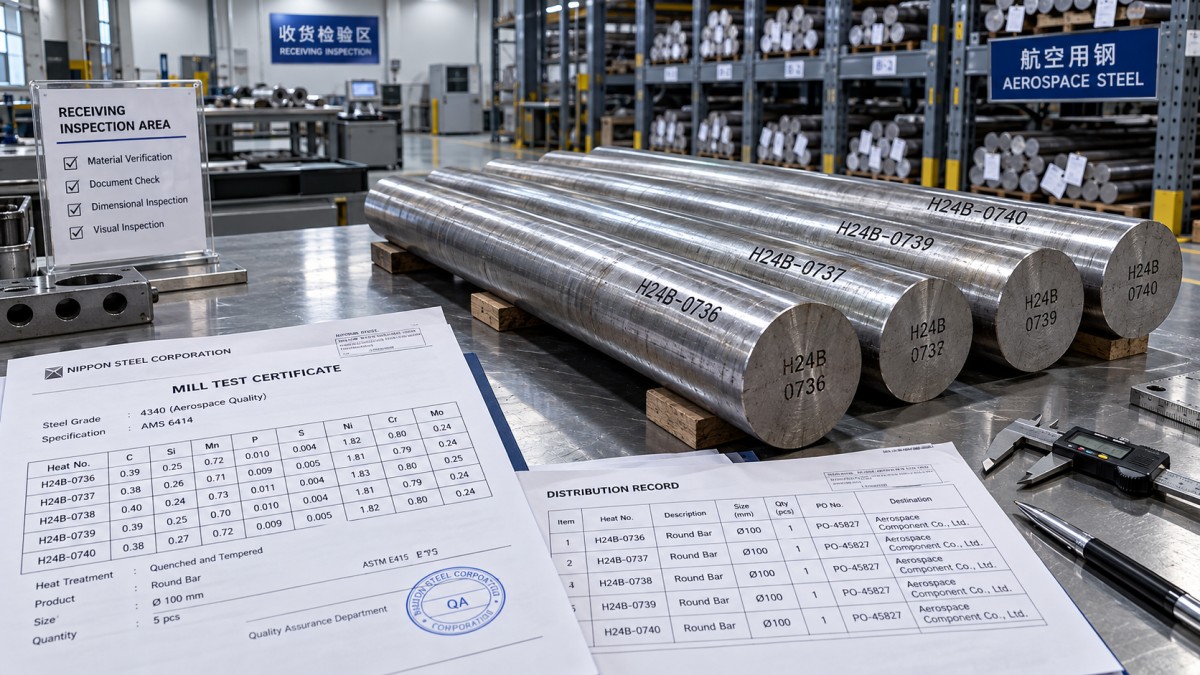
A useful traceability map connects the delivered identifier to each preceding record and shows where quantities were split or identifiers changed. Every transition should have supporting evidence; an unexplained jump is a gap, even when the documents on either side appear genuine.
Check splitting, cutting, and marking transfer
Cut lengths frequently lose the original mill marking. Ask how the supplier transfers identification, verifies the transfer, and controls unmarked remnants. Depending on the applicable requirements, identification may be maintained on individual pieces, controlled bundles, packaging, or another approved method.
The method must remain effective during storage and handling. A loose label beside several visually identical bars is weak evidence. A controlled bundle can be acceptable where permitted, but splitting it requires a defined way to preserve identity.
Read test results against the ordered condition
Confirm that the mill report covers the purchased product form and dimensional range. A report for an earlier billet or a different size does not automatically establish compliance of finished bar, plate, or forging stock. Additional processing and testing may be necessary under the applicable specification.
Review chemistry against all specified limits, including residual elements where required. Then examine the required mechanical and metallurgical results. Depending on the material specification, these may include tensile properties, hardness, impact performance, cleanliness, macrostructure, or other examinations. Do not treat this list as a universal aerospace testing requirement.
The test condition matters as much as the result. A strength value obtained after a specified laboratory heat treatment may support acceptance under some specifications, but it does not necessarily describe the material’s delivered condition. Check specimen orientation, test temperature, sampling basis, and heat-treatment condition wherever they affect acceptance.
Dates also provide a consistency check. Review whether the sequence of manufacturing, processing, sampling, testing, and certification is plausible. A reissued certificate can legitimately carry a later date; it should retain a clear connection to the original records rather than obscure them.
Resolve discrepancies without manufacturing a paper trail
When identifiers disagree, place the affected material on hold and request a written reconciliation supported by source records. Do not ask the supplier merely to change the certificate until it matches the marking. The investigation must establish which identity is correct and whether material control remained intact.
Administrative errors and missing provenance require different responses:
- Documented transcription error: Obtain a controlled correction from the responsible issuer, with the change identifiable and the previous record retained as required.
- Missing processor link: Request records connecting the incoming heat or lot to the output lot and relevant processing results.
- Unexplained relabeling or mixed stock: Maintain segregation and escalate through the supplier’s quality process. Do not release based on appearance or verbal assurance.
- Unverifiable certificate: Confirm authenticity with the issuing organization through independently established contact details, subject to any necessary authorization.
Formatting differences alone do not prove a certificate is false. More useful warning signs include conflicting identifiers, impossible process sequences, duplicated results across unrelated material, or an issuer unable to confirm the record. Review the substance and provenance together.
Independent testing has a defined limit
Positive material identification can help detect an alloy mix-up, but the instrument and method must suit the elements being assessed. Some handheld methods cannot reliably establish carbon content, which is critical for distinguishing certain steel grades. Select the method with qualified laboratory support where necessary.
Even accurate chemistry does not reconstruct melting history, processing history, source approval, or lot continuity. Mechanical testing also has sampling and representativeness limits. Independent testing can support an investigation; it cannot automatically restore missing provenance. Any acceptance through an alternative route requires authorization under the applicable contractual and quality requirements.
Compare suppliers on verification cost, not just material price
A lower quotation can become expensive when traceability records arrive only after shipment or require repeated clarification. Compare offers on the same documentary scope, including original mill records, relevant processor certificates, marking controls, and any required source restrictions.
Ask aerospace steel suppliers to provide a representative, suitably redacted document pack before qualification or award. Use it to assess whether records connect coherently, not simply whether the supplier possesses certificates. For higher-risk purchases, request an audit demonstration that traces selected inventory back to source records and forward through subsequent shipments.
A quality management certificate may support supplier evaluation, but it does not verify an individual shipment. Check its validity and scope separately from material acceptance. Likewise, an approved supplier listing does not remove the need to confirm that the quoted manufacturing and processing sources meet the order requirements.
Commercial comparison should include these cost exposures:
- Receiving inspection and document-review effort.
- Quarantine storage and production delays while discrepancies are resolved.
- Additional testing, including sample consumption where applicable.
- Return, replacement, and rescheduling costs if provenance cannot be established.
Direct mill purchasing can simplify parts of the chain, but it is not automatically the lowest-cost route for small quantities. A distributor with controlled splitting, reliable marking transfer, and complete records may offer a more practical purchase. Judge the route by demonstrated continuity and required approvals, not by the number of intermediaries alone.
Make traceability part of the order and release decision
Put documentary deliverables into the purchase order before accepting the quotation. Specify the required material identification, original-source reports, processing records, applicable specification revision, and restrictions on source or process changes. Require notification of substitutions rather than allowing an apparently equivalent grade or condition to pass without review.
Agree when records must arrive. Pre-shipment review can expose gaps before freight and production commitments accumulate, although it does not replace receiving verification. Define responsibility for discrepancy investigation, replacement, and associated costs in the commercial terms.
At release, the acceptance record should identify the shipment, supporting documents, reviewer, and any authorized disposition. If a gap remains, keep the material blocked from use until the designated quality or engineering authority resolves it under the applicable requirements. Production urgency is not evidence of identity, and a price concession does not close a traceability gap.
Related Industries
- How Collaborative Robots Improve Pharmaceutical Machinery OperationsDiscover how collaborative robots improve pharmaceutical machinery operations, from packaging and inspection to safer handling and smarter automation.
- What Should You Check When Buying Rice Milling Machines Wholesale?Buying rice milling machines wholesale? Learn how to verify capacity, rice recovery, operating costs, and supplier support to avoid costly mistakes and buy with confidence.
- Oct. 28 Rare Earth Magnet Index Eases as Pr-Nd Oxide Softens, Dysprosium Oxide RisesRare Earth Magnet Index fell 0.24% on Oct. 28, 2026, as Pr-Nd oxide softened and dysprosium oxide rose. Explore what diverging prices mean for magnet procurement and supplier quotes.
Weekly Insights
Stay ahead with our curated technology reports delivered every Monday.
Related Industries
Recommended News
- 00
0000-00
How to verify material traceability with aerospace steel suppliersEvaluate aerospace steel suppliers with confidence. Learn to verify mill reports, heat numbers, and processing records to close traceability gaps and avoid costly production delays.By Dr. Aris AlloyOct 26, 2026 - 00
0000-00
How to Evaluate Aerospace Steel for Strength, Weight, and ComplianceAerospace Steel selection made practical: evaluate strength, weight, heat treatment, fatigue, corrosion protection, and compliance for safer, audit-ready components.By Dr. Aris AlloyOct 06, 2026 - 00
0000-00
How Rockwell Hardness Supports ASTM Steel Grade SelectionRockwell hardness helps guide ASTM steel grade selection for wear, strength, heat treatment, and inspection. Learn how to specify the right material condition.By Dr. Aris AlloySep 10, 2026
0000-00
