Global Energy & Strategic Industrial (G-ESI)
When does quality control automation deliver measurable payback?
A quality control automation proposal often arrives on a finance approver’s desk with an attractive promise: fewer inspectors, faster decisions, more consistent output. That promise may be true, but it is not yet a business case. In capital-intensive industries, the real question is more demanding: when does quality control automation create measurable payback after equipment cost, integration risk, validation work, and ongoing operating expense are fully counted?
The answer is not “when inspection becomes automated.” It is when the system changes the economics of quality quickly enough to improve risk-adjusted cash flow. That usually happens where defects are expensive to discover late, production variability causes unstable throughput, compliance evidence is difficult to retrieve, or a single nonconforming component can trigger outage, recall, rejected shipment, or contractual exposure.
For procurement leaders and financial approvers in oil and gas infrastructure, specialty steel, agricultural machinery, robotics, nuclear-adjacent supply chains, and hydrogen projects, quality control automation should be evaluated as a control over loss—not simply as a labor-reduction initiative. The strongest investments reduce the hidden cost of poor quality while making conformance to API, ISO, ASTM, ASME, and customer-specific requirements easier to prove.
Payback begins with the cost of a defect, not the price of a camera or sensor
Many internal proposals begin with the purchase price of vision systems, automated gauging, robotic inspection cells, non-destructive testing platforms, or quality data software. This frames the decision too narrowly. The relevant baseline is the current cost of quality failure across the production and supply chain.
A defect found at an incoming-material checkpoint may require sorting and supplier recovery. The same defect found after machining can consume materials, machine time, energy, and labor. If it reaches final assembly, it can disrupt a build schedule. If it reaches the field, it may become a warranty claim, shutdown event, safety investigation, or regulatory concern. The cost curve rises sharply as detection moves downstream.
Quality control automation tends to deliver the clearest payback when it moves detection earlier and makes the result reliable enough to prevent recurrence. In practice, finance teams should ask for a quantified baseline across six categories:
- Scrap and rework: material loss, reprocessing, disposition effort, and engineering review.
- Yield loss: the value of production that cannot be sold at the intended grade or specification.
- Downtime and bottlenecks: waiting for manual inspection, retesting, release approvals, or containment actions.
- Labor deployment: repetitive inspection hours, overtime, and the cost of diverting skilled personnel from higher-value analysis.
- External failure exposure: warranty, penalties, expedited replacement, returns, and customer disruption.
- Compliance and traceability risk: incomplete records, inconsistent inspection evidence, and delayed audit response.
The investment case becomes credible when these costs are measured using production records, nonconformance reports, warranty data, maintenance history, and audit findings—not broad assumptions about “better quality.”
Where measurable returns appear fastest
Not every inspection point deserves automation. A low-volume process with changing geometries, subjective acceptance criteria, or limited historical defect cost may still be better served by trained human inspection supported by digital work instructions. Automation earns its place where the process is repeatable enough to control and the economic consequence of variation is substantial.
Consider a specialty steel operation producing high-strength plate or bar for demanding industrial applications. Automated surface inspection may produce value not merely by finding more indications, but by classifying defects consistently, linking results to heat and lot records, and preventing questionable material from progressing into expensive downstream processing. In this setting, yield protection and traceability can matter more than headcount reduction.
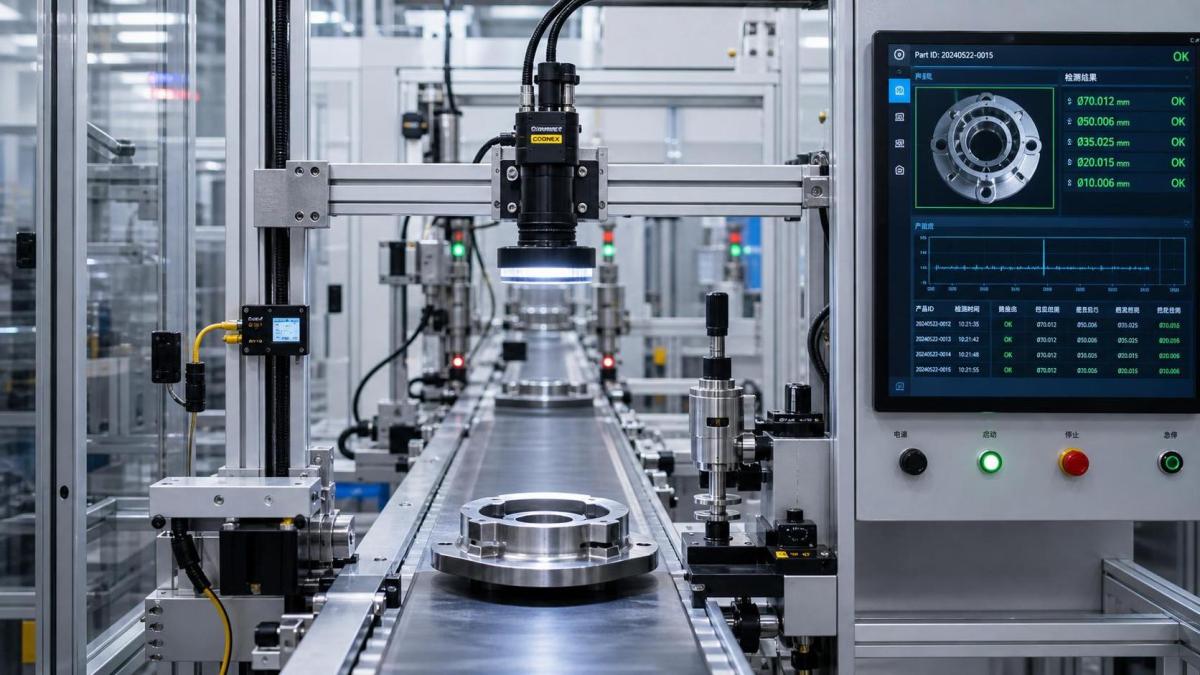
In an industrial machinery plant, automated torque verification, dimensional gauging, or vision-based assembly checks can protect takt time. If a manual inspection station creates queues, the benefit may come from throughput stability: fewer stoppages, fewer end-of-line surprises, and more predictable shipment dates. For procurement and finance teams, that matters because a stable production schedule reduces premium freight, overtime, and inventory buffers.
In oil and gas or future-energy equipment supply chains, the payback logic is often dominated by risk avoidance. Weld integrity, pressure-boundary components, coatings, material traceability, and documentation packages can carry consequences far beyond the cost of a single part. Here, quality control automation may justify itself through stronger evidence capture, rapid exception handling, and reduced likelihood that a nonconforming item moves into a high-consequence assembly.
A finance-ready model for quality control automation
Financial approval should not rely on a generic ROI percentage alone. The better approach is to model annual value, implementation timing, and downside risk separately. A practical structure is:
Annual net benefit = avoided internal failure cost + avoided external failure cost + labor capacity released + incremental throughput contribution + compliance-risk reduction − annual operating cost
Capital cost should include more than the equipment quotation. Include installation, fixtures, controls integration, software licensing, cybersecurity review, operator training, validation, process engineering, spare parts, and the expected period of reduced output during commissioning. If the automation depends on production data, include master-data cleanup and interface development with MES, ERP, QMS, or document-control systems.
For a disciplined approval, calculate three cases: a conservative base case, an expected case, and a downside case. The conservative case should assume a slower ramp-up, partial capture of labor benefits, and realistic maintenance costs. It should also distinguish between cost avoidance and cash savings. Reducing inspection hours matters, but it becomes a direct financial gain only when labor can be reduced, overtime is avoided, capacity is redeployed to a constrained operation, or external inspection spend declines.
Payback period remains useful because it is easy to communicate, especially where capital is constrained. Yet net present value and sensitivity analysis are more appropriate for assets with multi-year life, regulatory significance, or substantial integration work. If the business case survives lower defect rates, delayed ramp-up, and a higher-than-expected support cost, it is far more likely to deserve approval.
The threshold question: is inspection the constraint, or is the process unstable?
A common procurement error is buying automated inspection to compensate for an uncontrolled process. A vision system can identify a recurring surface defect; it cannot, by itself, correct the forming condition, tooling wear, material variation, temperature excursion, or programming error that causes it. The result may be faster sorting rather than true quality improvement.
Before approving a quality control automation project, ask whether the source of variation is understood. If the failure mechanism remains unclear, a pilot that combines automated detection with root-cause analysis may be more valuable than a full-scale deployment. This is especially important in complex fabrication and assembly environments, where a false sense of control can be expensive.
Automation is most defensible when the inspection result triggers a defined action: stop the process, adjust parameters, segregate a lot, initiate corrective action, block shipment, or request supplier containment. Detection without an operational response creates data, not payback.
Data integrity can be as valuable as defect detection
For organizations supplying regulated or high-consequence industries, quality records are commercial assets. Customers, auditors, insurers, and internal engineering teams may need to know not only whether a component passed, but which revision was used, which instrument performed the measurement, whether calibration was current, who released the result, and how deviations were resolved.
This is where quality control automation can create a less visible but important return. A connected inspection workflow can preserve time-stamped evidence, associate results with serial or heat numbers, apply controlled acceptance limits, and make records retrievable without days of manual document assembly. The benefit is not that every audit becomes effortless. Rather, the organization has a more defensible basis for demonstrating conformance when scrutiny arrives.
However, digital traceability only has value if governance is sound. Procurement should examine data ownership, retention rules, access controls, cybersecurity responsibilities, system validation requirements, and the supplier’s ability to support software updates over the asset life. A low-cost inspection platform that cannot meet enterprise data requirements may create a second investment later.
What separates a fundable proposal from an impressive demonstration
Technical demonstrations tend to emphasize detection accuracy under controlled conditions. Finance approvers should look further. Can the system handle normal variation in lighting, surface finish, product mix, temperature, contamination, operator handoff, and cycle-time pressure? What happens when it cannot classify a result confidently? How often will the model, sensor, or fixture require recalibration?
These questions are not signs of resistance to automation. They are the questions that protect the return. A useful procurement evaluation should require vendors and internal teams to define:
- the defect classes and acceptance criteria included in the scope;
- expected false-positive and false-negative handling procedures;
- integration responsibilities across controls, quality, IT, engineering, and operations;
- baseline performance data and the method used to validate improvement;
- site acceptance tests before final payment;
- support response, spare-parts availability, training, and lifecycle costs; and
- fallback procedures if the automated station is unavailable.
A phased purchase can reduce uncertainty. Start at one inspection point where defect cost, volume, and process repeatability are well understood. Establish a baseline, run the system in parallel with existing controls, verify performance across real operating conditions, then release expansion capital only after agreed measures have been achieved. This approach is often more credible than asking for an enterprise-wide commitment based on a laboratory trial.
When the answer is “not yet”
There are legitimate reasons to defer. If production volumes are too low, designs change weekly, inspection criteria are not standardized, or root causes remain unknown, the organization may not be ready for full automation. In those cases, investment in measurement-system analysis, standardized work, defect coding, supplier quality controls, process capability studies, or a digital quality management foundation may produce a better first return.
Likewise, a project should be challenged when its savings depend almost entirely on eliminating inspectors in an environment where those people will still be needed for first-article approval, complex judgment calls, audit support, and exception management. Automation frequently changes the role of quality professionals; it does not automatically remove the need for their expertise.
Make the approval decision around resilience as well as return
For strategic industrial operations, the value of quality control automation is rarely confined to a single workstation. A well-designed system can protect margin, reduce production surprises, preserve customer confidence, and create evidence that supports compliance across global supply chains. Those benefits become measurable when they are tied to actual defect pathways, operational constraints, and documented exposure.
The investment delivers payback when it prevents costly failures earlier than current controls, releases a real bottleneck or cost burden, and remains reliable in day-to-day production—not just during a vendor demonstration. For financial approvers, the practical standard is clear: approve automation when its assumptions can be audited, its risks are priced, and its value is visible in yield, throughput, cost of quality, and conformance performance over time.
Related Industries
- What Hydrogen Transport News Reveals About Infrastructure InvestmentDiscover what hydrogen transport news reveals about infrastructure investment. Assess demand, delivery costs, and project risks to identify opportunities worth pursuing.
- Megawatt-Scale PEM Electrolyzer Completes Grid Connection Testing in NorwayMegawatt-scale PEM electrolyzer completes grid connection testing in Norway. Explore reported dynamic-load performance and key checks for green hydrogen procurement.
- How to Choose a Beryllium Copper Rod for Strength and ConductivityChoose the right beryllium copper rod for strength and conductivity. Compare alloy grades, tempers, ASTM standards, and supplier certificates to make a confident purchasing decision.
Weekly Insights
Stay ahead with our curated technology reports delivered every Monday.
Related Industries
Recommended News
- 00
0000-00
How Vision Guided Deburring Robots Improve Welded Part QualityVision guided deburring robot solutions improve welded part quality with adaptive edge finishing, safer workflows, and traceable process control.By Dr. Victor GearOct 11, 2026 - 00
0000-00
How Welding Robot Benchmarking Reveals the Best Fit for Your LineWelding robot benchmarking reveals the best-fit automation platform by comparing weld quality, integration, safety, lifecycle cost, and real-world production resilience.By Dr. Victor GearOct 10, 2026 - 00
0000-00
When does quality control automation deliver measurable payback?Quality control automation delivers measurable payback by reducing defect costs, protecting throughput, strengthening traceability, and improving risk-adjusted cash flow.By Dr. Victor GearSep 02, 2026
0000-00
