
Global Energy & Strategic Industrial (G-ESI)
How Do Integration Setups Change Industrial Robot Total Cost?
How Do Integration Setups Change Industrial Robot Total Cost?
An industrial robot quotation can create a false sense of certainty. The robot arm, controller, and basic software may appear to define the project budget, but they rarely define the full investment. In a real production environment, the robot must be connected to parts, tooling, safety systems, upstream and downstream equipment, plant utilities, quality controls, operators, maintenance teams, and production data. Integration is where those connections become physical, programmable, validated, and supportable.
That is why two facilities can purchase similar robot models for apparently similar tasks and end up with very different total costs. One may install a robot in a stable, guarded cell with repeatable parts and a familiar PLC architecture. Another may need a mobile platform, machine vision, custom fixtures, hazardous-area considerations, traceability, operator access, and multi-site cybersecurity controls. The arm is similar; the integration burden is not.
For procurement directors, the useful question is not simply, “What does the robot cost?” It is: “What operating system around the robot must be engineered for this process to run safely, repeatedly, and economically?” That broader view is especially relevant for strategic industries, where an automation outage can affect production continuity, worker safety, contractual delivery, or regulated asset performance.
The Robot Is Only One Line in the Capital Budget
A conventional robotic workcell often includes much more than the manipulator. End-of-arm tooling must hold, weld, cut, dispense, inspect, palletize, or otherwise interact with the product. Fixtures must locate the part consistently. Conveyors, turntables, feeders, safety fencing, interlocked doors, scanners, electrical cabinets, pneumatic circuits, and plant-network connections all require design and commissioning. If the robot supports a process such as welding, painting, machining, or material removal, process-specific equipment can exceed the cost of the robot itself.
The same is true for software. A cell may need robot programming, PLC logic, safety logic, human-machine interface screens, recipe management, error recovery routines, historian connections, manufacturing execution system interfaces, and remote-service rules. These are not decorative additions. They determine whether the installation can recover from a misloaded part at 2 a.m. without waiting for a specialist.
Integration scope also changes when a production line is being retrofitted. Existing machinery may have incomplete drawings, obsolete controllers, inconsistent wiring practices, or undocumented safety modifications. In those conditions, a low initial equipment quote can be misleading. Time spent surveying the line, rebuilding interfaces, and resolving legacy faults belongs in the project cost, even when it does not appear on a robot manufacturer’s price list.
Cell Design Determines Whether Safety Is a Cost or a Constraint
Safety engineering is one of the clearest examples of how integration changes industrial robot total cost. It is also one of the areas where cost cutting can produce expensive consequences. A robot operating at speed with heavy payloads, sharp tools, hot workpieces, or stored energy cannot be made safe merely by installing an emergency-stop button. The hazards arise from the entire system: robot motion, gripper behavior, part release, conveyor movement, tool process, access routes, maintenance modes, and foreseeable misuse.
Standards commonly considered in robotic system design include ISO 12100 for risk assessment and risk reduction, ISO 10218 for industrial robot and robot system safety, ISO 13849-1 or IEC 62061 for safety-related control systems, and IEC 60204-1 for electrical equipment of machines. The applicable standards, legal duties, and conformity processes depend on the jurisdiction and the final machine configuration. A component may be compliant in isolation while the completed integrated cell still requires its own assessment and validation.
The design choice matters. A fixed perimeter guard may be economical where operators have little reason to enter the cell. A collaborative arrangement may reduce fencing in some applications, but it does not remove the need for risk assessment. Reduced-speed operation, power-and-force limiting, monitored stops, or safety-rated monitored space can require additional sensing, validated safety functions, and carefully defined operating modes. In high-throughput applications, a collaborative robot may be technically possible yet commercially inferior to a conventional guarded cell because cycle time and payload requirements drive the design.
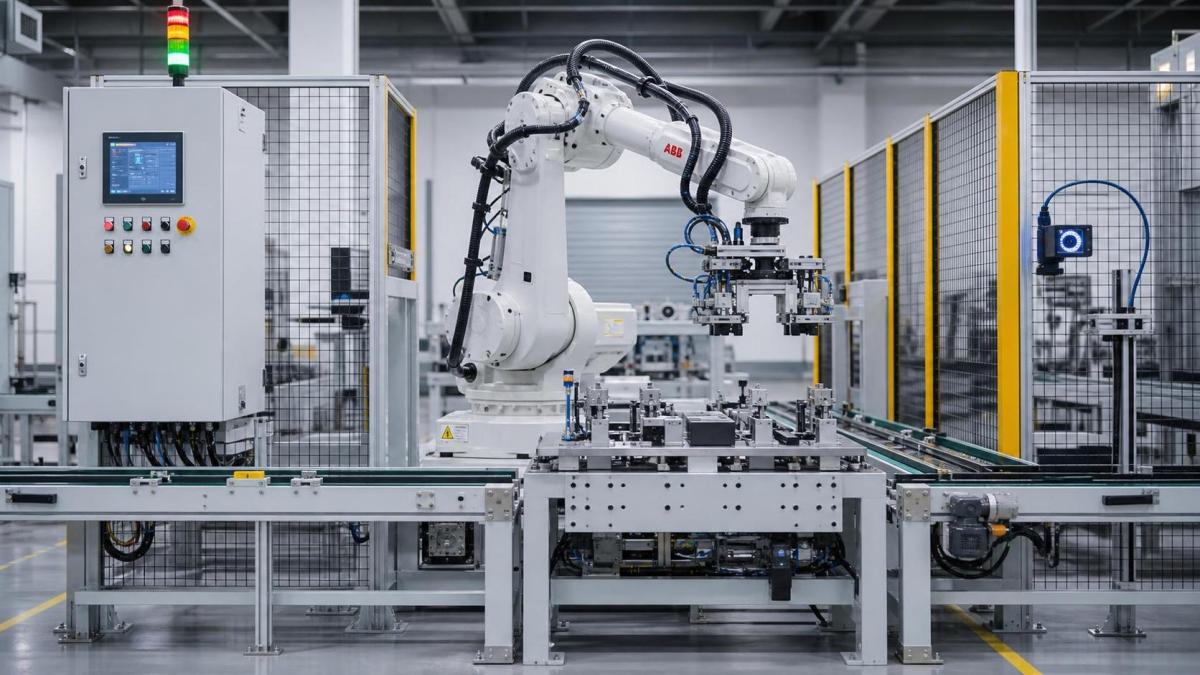
Good safety integration should also account for normal intervention. If operators must enter the cell repeatedly to clear jams, load inserts, inspect quality, or change consumables, the system needs a realistic access and restart strategy. A design that is safe on a layout drawing but awkward in daily use can create bypass behavior, lost production time, and difficult maintenance. The lowest-cost guard package is not necessarily the lowest-cost operating arrangement.
Why Autonomous Tractor Safety Is a Useful Comparison
The question, “What safety standards must autonomous tractors meet near human workers?” is closely related to robotic-cell procurement because both involve risk-based system integration rather than a single device feature. An autonomous agricultural machine must be evaluated in its intended operating environment: field boundaries, terrain, implements, detection capability, remote supervision, foreseeable worker presence, and response to obstacles or communications loss.
For highly automated agricultural machines, ISO 18497 is an important reference for safety principles. ISO 25119 addresses safety-related parts of control systems for agricultural and forestry machinery, while the ISO 4254 series addresses safety requirements for agricultural machinery more broadly. These references do not replace local legal review, and their relevance depends on the tractor, implement, automation level, market, and operating conditions. Requirements may also arise from national machinery rules, workplace obligations, and road-use restrictions where applicable.
The core lesson transfers directly to industrial robots: human proximity cannot be treated as a generic condition. A tractor operating in an open field and a robot loading a press brake have different hazards, but both require defined safe states, reliable detection or separation measures where needed, controlled restart behavior, operator instructions, and verification that the safety functions work in the actual environment. Procurement teams should be cautious when a supplier describes a machine as “autonomous” or “collaborative” without explaining the operating envelope and the conditions under which people may safely approach it.
Integration Complexity Shows Up Later as Downtime
Capital expenditure is only part of total cost of ownership. The larger financial impact may emerge after handover, when production teams encounter part variation, sensor contamination, network interruptions, software faults, consumable wear, or tooling damage. A well-integrated cell is designed not only to run a nominal cycle, but also to identify faults clearly and recover predictably.
Consider machine vision. It can reduce the need for precise part presentation, but it introduces lighting design, calibration routines, image quality controls, camera protection, processing latency, and maintenance requirements. In a dusty metals operation, a lens-protection and cleaning strategy may matter as much as the vision algorithm. In food, agricultural, or chemical environments, washdown requirements and material compatibility can reshape enclosure, cable-routing, and tooling decisions.
Serviceability deserves equal attention. Can maintenance personnel reach valves, dress packs, sensors, and electrical components without dismantling half the cell? Are spare parts locally obtainable? Does the control architecture permit a competent plant technician to diagnose common faults? Is there a documented backup of robot, PLC, HMI, drive, and safety configurations? These details are not usually visible in a demonstration, yet they influence availability over years of operation.
A Better Way to Compare Automation Proposals
Comparing proposals on robot brand, payload, and reach alone encourages an incomplete decision. A more useful comparison separates the system into clear technical and commercial responsibilities. Buyers should ask what is included in the functional scope, what assumptions govern cycle time, how part variation has been handled, and who is responsible for final risk assessment, safety validation, installation, and site acceptance.
The acceptance criteria should be written before detailed integration begins. They may cover product mix, throughput conditions, quality thresholds, permitted operator interventions, planned changeovers, utility availability, safety functions, training, documentation, and fault recovery. This is not bureaucracy. It prevents a common dispute in which a supplier demonstrates motion while the buyer expected dependable production performance under plant conditions.
It is also sensible to distinguish between known engineering work and unresolved technical risk. A mature palletizing cell with stable cartons is different from a first-of-its-kind assembly process involving deformable components or inconsistent incoming materials. When uncertainty exists, feasibility trials, representative samples, digital simulation, or phased commissioning may cost money upfront but can prevent poorly defined scope from reappearing as late change orders.
Benchmark the System, Not Just the Hardware
For multinational industrial groups, automation decisions often sit alongside broader concerns: energy resilience, labor availability, supply-chain exposure, export requirements, and evolving environmental or safety obligations. This is where a cross-sector perspective has practical value. The integration problems found in industrial robotics, autonomous tractors, specialty-steel processing, energy infrastructure, and advanced manufacturing are different in detail but similar in discipline: equipment selection must be tested against operating conditions, standards, interfaces, and lifecycle responsibilities.
Global Energy & Strategic Industrial (G-ESI) approaches this question through technical benchmarking and regulatory context across industrial robotics, advanced agricultural machinery, strategic metals, energy infrastructure, and future-energy systems. For a procurement review, the most useful output is not a generic recommendation. It is a traceable view of what has been specified, which standards and assumptions apply, where project risk remains, and whether the proposed integration architecture supports the required operating model.
Industrial robot total cost changes when the integration setup changes because integration determines the real machine: its safe boundaries, its process capability, its recoverability, and its support burden. Before approving a budget, decision-makers should require a complete scope map, a site-specific risk strategy, defined acceptance conditions, and a lifecycle plan for software, spares, training, and modification control. The robot purchase is a component decision. The integration design is the investment decision.
Related Industries
- How much does a 500 ton grain silo cost to purchase and install?Planning a 500 ton grain silo? Explore purchase and installation cost factors, uncover hidden expenses, and learn how to compare quotes for a reliable project budget.
- DOE Authorizes Strategic Petroleum Reserve Exchange to Support Fuel SupplyExplore the reported DOE Strategic Petroleum Reserve exchange of up to 4 million barrels, its fuel supply goals, and repayment obligations for crude buyers and refiners.
- How to Choose Offshore Cables for Wind Farm Projects in EuropeChoose the offshore cable Europe’s wind farms need. Learn how to compare ratings, seabed conditions, installation limits and supplier evidence to reduce project risk.
Weekly Insights
Stay ahead with our curated technology reports delivered every Monday.
Related Industries
Recommended News
- 00
0000-00
How to Choose a Robotic Gripper Manufacturer for Your ApplicationChoose a robotic gripper manufacturer with confidence. Learn how to evaluate gripping performance, integration, testing, and lifecycle costs to find the right fit for your application.By Dr. Victor GearOct 17, 2026 - 00
0000-00
What Maintenance Costs Follow Industrial Robot Deployment?What ongoing maintenance costs should I budget for after industrial automation deployment? Explore robot servicing, spare parts, safety checks, and downtime to build a smarter budget.By Dr. Victor GearOct 13, 2026 - 00
0000-00
How to Evaluate High-Speed Automation Solutions Before Expanding Production CapacityHigh-speed automation solutions: evaluate sustained throughput, quality, integration, flexibility, and lifecycle costs before expanding capacity.By Dr. Victor GearSep 28, 2026
0000-00
