
Global Energy & Strategic Industrial (G-ESI)
What Maintenance Costs Follow Industrial Robot Deployment?
What Maintenance Costs Follow Industrial Robot Deployment?
What ongoing maintenance costs should I budget for after industrial automation deployment? The answer extends beyond routine servicing: spare parts, lubrication, calibration, software support, safety inspections, and unplanned downtime all shape lifecycle costs. Industrial robot maintenance budgets must also reflect operating hours, application demands, warranty coverage, and access to qualified technicians.
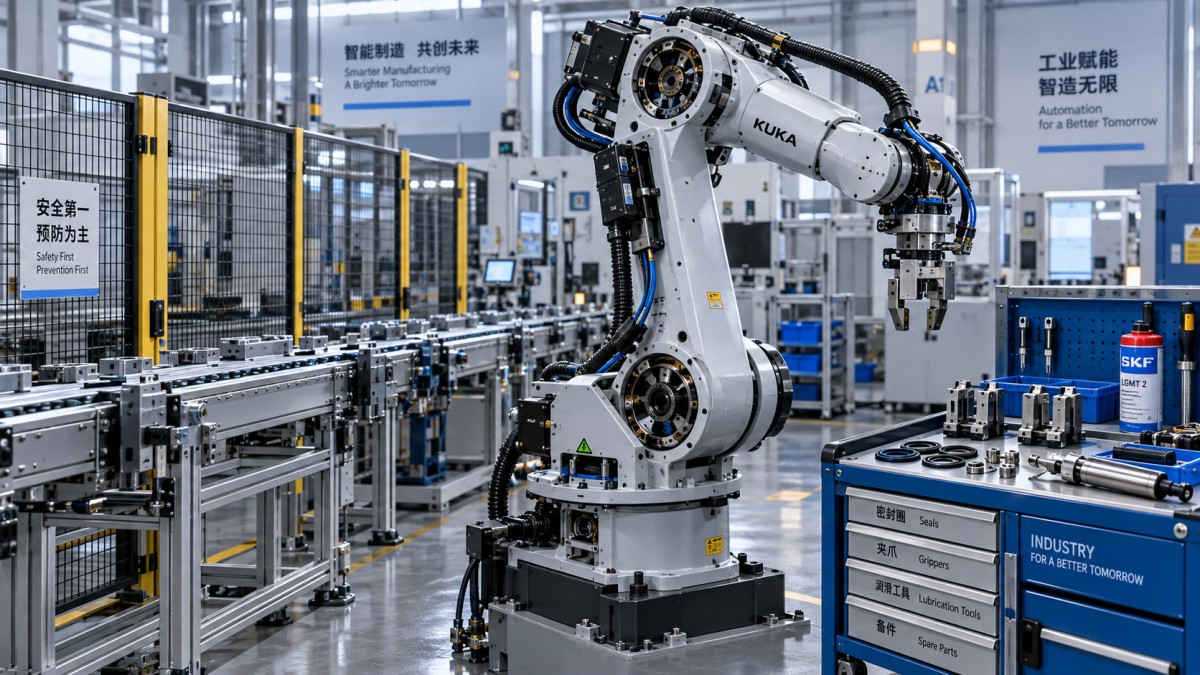
The expensive mistake is treating the robot arm as the entire maintenance responsibility. A working cell includes tooling, cables, sensors, guarding, controllers, and connections to upstream and downstream equipment. A relatively inexpensive failed gripper seal can stop production just as effectively as a damaged robot gearbox. A credible budget follows the production system, not simply the equipment invoice.
Define the maintenance boundary before estimating costs
Start with an asset register covering the complete installation. Separate the robot and controller from end-of-arm tooling, process equipment, safety systems, and supporting utilities. Record who owns each maintenance task: the plant, robot manufacturer, integrator, or specialist contractor. Without that boundary, service quotations can appear comparable while covering very different responsibilities.
For a welding cell, recurring work may include torch consumables, wire-feed components, extraction equipment, and cable management. A palletizing installation introduces vacuum cups, pneumatic components, conveyors, and product-detection sensors. Machine-tending applications can require attention to coolant exposure, chip contamination, fixtures, and machine-interface signals. These are different maintenance profiles even when the robot models are identical.
Keep maintenance distinct from energy consumption and production materials, but include all three in total cost of ownership. Also distinguish the cost of performing maintenance from the production time it consumes. Otherwise, shutdown allowances can disappear between the maintenance budget and the operations forecast.
The recurring expenses that belong in the budget
Scheduled service, labor, and consumables
Preventive maintenance commonly covers lubrication, inspection, cleaning, cable checks, and replacement of specified service items. Exact tasks and intervals should come from the manuals for the installed robot, controller, and peripheral equipment. Some are driven by operating hours, others by calendar time or condition. Do not transfer a maintenance schedule from a similar-looking machine without checking its applicability.
The labor allowance should include safe isolation, access, servicing, reassembly, testing, and production release—not just the minutes spent changing a component. Contractor travel, minimum callout charges, overtime, and specialist equipment can materially change the invoice. Internal technicians are not free either; their time needs an agreed costing basis.
Consumable specifications matter. Lubricant compatibility, quantity, and application method should follow manufacturer instructions. Battery replacement may require model-specific procedures to preserve position data. A low-cost service item becomes expensive if incorrect handling creates a recovery task or extended shutdown.
Wear parts, repairable assemblies, and spare inventory
Dress packs, flexible cables, hoses, gripper components, and process tooling deserve particular attention because their exposure follows the application. Repeated bending, abrasion, heat, and contamination can make these items more demanding than the robot’s internal mechanisms. Motion paths and cable routing therefore influence maintenance costs as well as cycle time.
Controllers, drives, motors, and gear assemblies require a different budgeting approach. Rather than assuming annual replacement, evaluate failure consequences, repair options, availability, and lead times. For some components, an exchange arrangement may be more practical than owning a spare; for others, local stock may be necessary to protect production.
Separate the initial spare-parts purchase from annual replenishment and inventory carrying costs. Check storage requirements and shelf life where relevant. Avoid charging the same spare once as inventory investment and again as expected annual consumption.
Accuracy checks, software, and technical support
Calibration costs depend on what the process needs. Robot repeatability, absolute positioning accuracy, tool-center-point accuracy, and vision alignment are not interchangeable. A precision assembly operation may need verification that a straightforward transfer operation does not. Define acceptable process performance before paying for a generic annual calibration package.
Allow for recovery work after collisions, tooling changes, or component replacement when these events require mastering, alignment, or process checks. External metrology equipment and specialist support may be needed, depending on the acceptance criteria.
Software expenses can include support agreements, programming tools, vision licenses, remote-access services, and controller or industrial-PC lifecycle support. Not every installation requires every subscription. Ask which charges preserve essential functionality, which provide updates, and which are optional conveniences. Retain verified backups of programs, parameters, safety configurations, and relevant licenses, with a documented restoration procedure.
Safety maintenance is more than checking a checklist
Guard interlocks, emergency stops, protective devices, and safety-related control functions need inspection or testing appropriate to the cell design and applicable requirements. Relevant references can include the ISO 10218 series for industrial robot safety and ISO 13849 for safety-related control systems. Confirm the applicable editions, local requirements, and contractual obligations rather than assuming one standard settles every question.
Periodic checks and validation after a change are different activities. New tooling, revised layouts, altered speeds, or modified safety logic may require reassessment and additional validation. A collaborative robot does not remove the need to assess the complete application, including payloads, sharp edges, trapping points, and surrounding machinery.
Budget for competent personnel, records, and production release after safety-related work. Responsibility should be explicit, especially where multiple contractors can change the cell.
Operating conditions matter more than a generic percentage
A fixed percentage of purchase price can serve as an early placeholder, but it is a weak final budget. Capital price does not capture production intensity, environmental exposure, or service accessibility. A lower-cost installation with difficult recovery procedures may create greater operating risk than a more expensive, maintainable cell.
- Duty: Track operating hours, motion cycles, payload, acceleration, and time spent under demanding loads.
- Environment: Assess dust, welding spatter, moisture, washdown chemicals, temperature, and corrosive exposure against equipment specifications.
- Access: Check whether technicians can reach service points without removing major fixtures or disturbing adjacent equipment.
- Recovery: Establish whether a stopped cell has a workable bypass, manual fallback, or alternative production route.
- Support: Verify local technician availability, parts distribution, and practical response times for the installed models.
Across agricultural machinery, metals processing, and energy-related manufacturing, these conditions vary substantially. G-ESI’s multidisciplinary benchmarking approach is useful here: compare hardware capability with operating conditions, maintainability, and applicable safety requirements. A shared robot platform does not make unlike applications equally costly to support.
Budget downtime without exaggerating it
Repair cost and business interruption are separate exposures. Recovery time includes fault detection, diagnosis, waiting for parts, safe repair, testing, and restarting the process. A service provider’s response-time commitment may cover only acknowledgement or arrival—not restoration of production.
For each critical failure scenario, estimate the affected output, recoverable production, scrap, restart labor, and potential delivery consequences. Use contribution margin or another finance-approved measure for genuinely lost production, rather than automatically treating all delayed sales revenue as a loss. Include overtime needed to catch up only where it is a plausible consequence.
Avoid false precision when failure history is unavailable. Develop a normal operating budget and a separate disruption scenario, documenting the assumptions behind each. After deployment, maintenance records and production-loss data should replace those assumptions progressively.
Compare service agreements by what they actually cover
Warranty coverage should not be treated as a maintenance plan. Review whether wear parts, process tooling, travel, labor, and peripheral equipment are included or excluded. Check operating conditions and maintenance documentation requirements that may affect claims. Coverage for a robot component does not necessarily cover the cost of restoring the full cell.
When comparing service offers, request a common scope with clear answers to these questions:
- Which assets and scheduled tasks are covered, and at what intervals?
- Are emergency labor, travel, overtime, and replacement parts included?
- Does the response commitment mean remote contact, site attendance, or repair?
- What support is available outside normal working hours?
- Who owns backups, diagnostic access, and recovery documentation?
- How are renewal pricing, obsolete components, and unresolved faults handled?
A hybrid model can be practical: plant technicians handle inspections and approved routine tasks, while specialists support major repairs or validation. Its viability depends on training, tools, staffing, and manufacturer requirements—not simply a preference to reduce contractor spending.
Turn the maintenance estimate into an accountable plan
Build the annual cash budget from scheduled labor, consumables, support fees, inspections, spare replenishment, training, and a justified corrective-maintenance allowance. Keep initial spares, major refurbishment, and production-loss exposure visible as separate items. A multi-year forecast helps reveal costs that do not recur evenly each year.
Before accepting the installation, obtain the maintenance schedules, as-built documentation, critical-parts list, backup package, warranty terms, and recovery responsibilities. Confirm that technicians can perform the required work safely and that quoted service coverage matches the equipment actually delivered.
The strongest maintenance estimate is traceable: each cost has an asset, task, interval, rate, and owner. Each major downtime risk has a recovery route. If those details remain unclear, the deployment is not yet fully costed—regardless of how attractive the purchase price looks.
Related Industries
- How much does a 500 ton grain silo cost to purchase and install?Planning a 500 ton grain silo? Explore purchase and installation cost factors, uncover hidden expenses, and learn how to compare quotes for a reliable project budget.
- DOE Authorizes Strategic Petroleum Reserve Exchange to Support Fuel SupplyExplore the reported DOE Strategic Petroleum Reserve exchange of up to 4 million barrels, its fuel supply goals, and repayment obligations for crude buyers and refiners.
- How to Choose Offshore Cables for Wind Farm Projects in EuropeChoose the offshore cable Europe’s wind farms need. Learn how to compare ratings, seabed conditions, installation limits and supplier evidence to reduce project risk.
Weekly Insights
Stay ahead with our curated technology reports delivered every Monday.
Related Industries
Recommended News
- 00
0000-00
How to Choose a Robotic Gripper Manufacturer for Your ApplicationChoose a robotic gripper manufacturer with confidence. Learn how to evaluate gripping performance, integration, testing, and lifecycle costs to find the right fit for your application.By Dr. Victor GearOct 17, 2026 - 00
0000-00
What Maintenance Costs Follow Industrial Robot Deployment?What ongoing maintenance costs should I budget for after industrial automation deployment? Explore robot servicing, spare parts, safety checks, and downtime to build a smarter budget.By Dr. Victor GearOct 13, 2026 - 00
0000-00
How to Evaluate High-Speed Automation Solutions Before Expanding Production CapacityHigh-speed automation solutions: evaluate sustained throughput, quality, integration, flexibility, and lifecycle costs before expanding capacity.By Dr. Victor GearSep 28, 2026
0000-00