
Global Energy & Strategic Industrial (G-ESI)
Impossible Metals Tests AI-Powered Seabed Mining Robot
Impossible Metals says its Eureka robot successfully recovered polymetallic nodules during a test at a depth of more than 4,000 metres in the Pacific Ocean. The date of the event was not specified. The announcement provides no evidence of a new mining rule, environmental standard or certification requirement, but it raises questions about how selective collection and environmental claims might be assessed in future. For equipment suppliers, prospective buyers and testing providers, the distinction between a technical demonstration and an accepted basis for commercial operations deserves attention.
What the Eureka test demonstrated
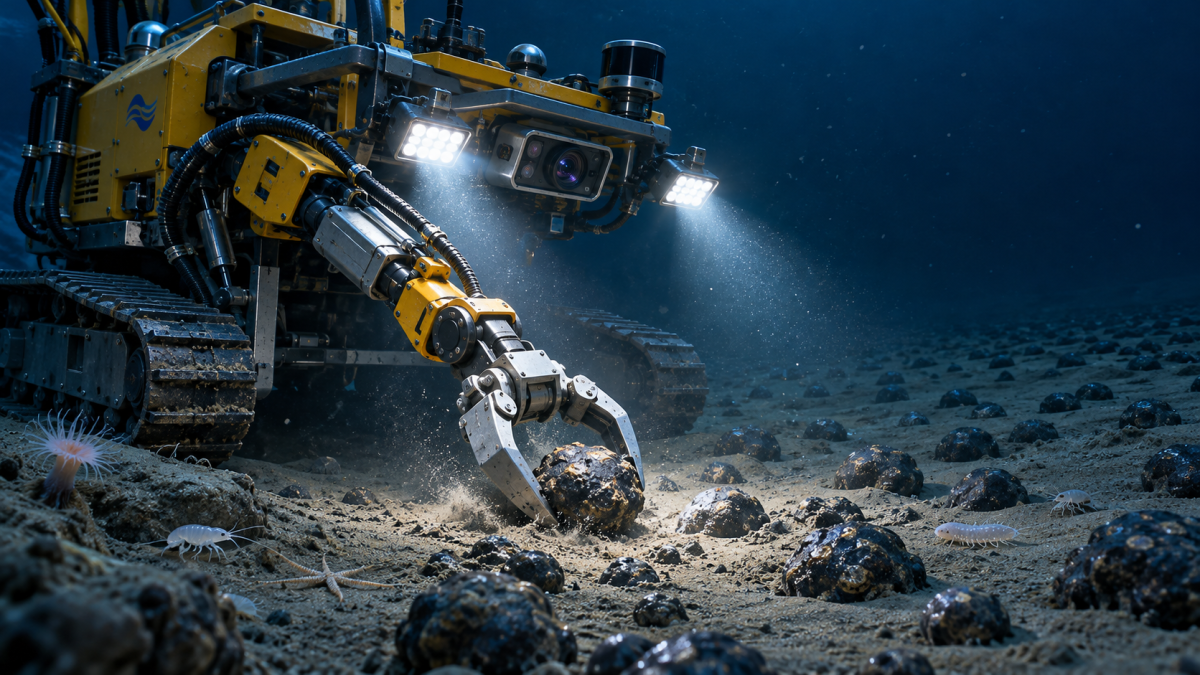
Deep-sea mining company Impossible Metals announced that its Eureka robot completed a successful test in the Pacific at a depth of more than 4,000 metres. According to the supplied event summary, Eureka became the first system to selectively recover polymetallic nodules.
The robot has large mechanical claws and uses artificial intelligence to identify and avoid marine life, with the aim of reducing environmental impact. The test collected approximately 450 grams of nodules. Impossible Metals plans to deploy a larger Eureka III system for independent environmental testing in 2027.
From selective collection to supply-chain decisions
Equipment suppliers face questions about evidence
From an industry perspective, the test may prompt prospective equipment customers to examine how selective collection is demonstrated. Suppliers and integrators could be asked to explain the operating conditions under which a robot identifies material, avoids marine life and controls its mechanical claws. The supplied information does not establish a required performance threshold or a prescribed method for measuring those capabilities.
In a procurement process, analysis suggests that the description of a system may matter as much as the headline claim. Buyers could seek clarity on what the AI identifies, what evidence supports its performance and how limitations are recorded. Such questions would be commercial and technical due diligence at this stage; the announcement does not establish that any particular documentation is mandatory.
Prospective raw-material buyers need a measured view
For companies considering nodules as a potential input, the reported recovery shows a test result rather than a confirmed commercial supply arrangement. The approximately 450-gram sample gives prospective buyers a reason to follow the technology, but it does not establish available volumes, delivery schedules, product specifications or pricing.
Analysis suggests that procurement teams may eventually want evidence connecting the collection method to material identification, handling and traceability. They may also need to understand which environmental representations can be supported by test records. Until further details are available, treating the announcement as a basis for a delivery commitment would require assumptions that the supplied information does not support.
Testing providers may be drawn into the next stage
The planned independent environmental testing of Eureka III points to a possible role for organizations able to assess environmental evidence. From an analytical standpoint, the value of such work will depend on questions that remain open in the supplied summary: what is measured, how results are evaluated and whether the findings can be compared with the claims made for selective recovery.
For companies preparing technical or purchasing documents, these questions could influence how test reports are requested and reviewed. The announcement does not identify a testing body, a recognized certification scheme or an assessment protocol, so none should be assumed to apply on the basis of this event alone.
What companies can examine before making commitments
Separate the demonstration from the environmental claim
The robot is described as using AI to identify and avoid marine life in order to reduce environmental impact. Analysis suggests that companies reviewing this claim should distinguish the stated design objective from independently assessed environmental outcomes. The supplied information confirms neither the scope of the future assessment nor its conclusions.
A practical first step would be to request available descriptions of the test conditions and the evidence behind the identification and avoidance functions. Reviewers could also ask what the test did and did not measure. Those questions can help a prospective customer understand the limits of a claim without assuming that the test has satisfied a particular regulatory standard.
Follow the planned independent test and its scope
The proposed 2027 deployment of the larger Eureka III system is a point to monitor, not a completed milestone. Companies evaluating the technology could track whether details emerge about the assessment scope, the information to be published and the relationship between the larger system and the tested Eureka robot.
From a purchasing perspective, the distinction matters because results for one configuration may not automatically answer questions about another. If organizations use future findings in specifications or supplier reviews, they may need to check which equipment and operating conditions those findings cover. The supplied summary does not describe the planned test in enough detail to resolve those questions now.
Review documents and claims throughout the chain
Analysis suggests that equipment purchasers, potential material buyers and service providers could prepare a list of documents they would want to review as a project develops. Depending on the transaction, these might include technical descriptions, test reports, sample records and statements explaining the basis for environmental claims. Their relevance would depend on the actual agreement and applicable requirements, none of which are specified in the input.
Where a future transaction involves trade or delivery, parties could also verify the rules and documentation applicable to that particular transaction before making commitments. The test announcement does not identify a destination, trade route, customs classification or delivery arrangement, and it does not establish a change to any of them.
Keep procurement decisions proportionate to the evidence
For teams assessing a potential supply chain, a useful approach may be to maintain separate records for demonstrated facts, company plans and matters awaiting independent verification. The reported sample can be recorded as a test outcome; the larger system and environmental assessment remain plans. This distinction may help prevent preliminary technical information from being treated as proof of commercial readiness.
Companies considering equipment or material purchases could also identify decisions that depend on further evidence, such as product specifications, supplier qualifications or delivery terms. Analysis suggests that keeping those decisions conditional may be appropriate while the test scope, future results and any relevant project-specific requirements remain unknown.
A technical signal with rules still to be established
At this stage, it is more appropriate to understand the announcement as a technology and evidence signal than as an implemented rule change. The supplied information reports a selective recovery test and a plan for independent environmental testing; it does not report a new policy, permit decision, environmental standard, certification requirement or trade rule.
That distinction matters for industry interpretation. Selective recovery and AI-based avoidance could become relevant to future assessments or purchasing criteria, but the supplied information does not say whether any authority, customer or standards body will adopt them. Nor does it establish that a successful test alone would meet the requirements of a future project.
Further observation should focus on the content and results of the planned environmental testing, as well as any later official statements, applicable rules, procurement specifications and industry responses. Their practical significance would depend on what they actually require or demonstrate. Until those details are available, the scale and timing of any effect on compliance, trade or procurement remain uncertain.
Keeping the result in proportion
The Eureka test adds a reported example of AI-assisted selective recovery to the evidence available for assessing deep-sea mining technology. The planned Eureka III assessment may provide further information, but its scope and findings are not yet available in the supplied material. For businesses, the appropriate response is to monitor verifiable developments, scrutinize technical and environmental claims, and avoid treating a small test sample or a future testing plan as an established commercial or regulatory outcome.
Basis for this report and points to verify
This article is based on the user-provided news title, event-time information and event summary. The event date was not specified. No specific official source link was provided in the input, and the announcement and its details require further verification.
Future verification could draw on the company's official announcements, relevant regulatory publications, standards documents, independent testing reports and authoritative industry reporting where available. Continued observation is needed for any policy details, assessment or certification criteria, procurement document changes, trade implementation and industry feedback relevant to subsequent projects.
Related Industries
- EXIM Bank Reviews Export Financing for Papua New Guinea LNG InfrastructureEXIM Bank reviews export financing for Papua New Guinea LNG infrastructure. Explore potential impacts on suppliers, procurement and project timelines.
- Fincantieri Delivers Viking Libra, Viking’s First Hydrogen Fuel Cell Cruise ShipExplore Fincantieri’s delivery of Viking Libra, Viking’s first hydrogen fuel cell cruise ship, and what its hybrid power system means for cruise operations.
- How to Compare Oil Spill Recovery Equipment SuppliersCompare oil spill recovery equipment suppliers with a practical buyer’s guide to system performance, compliance, lifecycle costs, delivery, and support.
Weekly Insights
Stay ahead with our curated technology reports delivered every Monday.
Related Industries
Recommended News
- 00
0000-00
How to Compare Oil Spill Recovery Equipment SuppliersCompare oil spill recovery equipment suppliers with a practical buyer’s guide to system performance, compliance, lifecycle costs, delivery, and support.By Dr. Marcus CrudeNov 28, 2026 - 00
0000-00
Wood Wins FEED Contract for Spain–France Subsea Hydrogen PipelineWood wins the FEED contract for the proposed Spain–France subsea hydrogen pipeline. Explore the €2.4 billion project and its next steps.By Dr. Marcus CrudeNov 26, 2026 - 00
0000-00
How Do Deepwater Drilling Depth Standards Affect Well Design?Discover how deepwater drilling depth standards shape casing, riser and well-control decisions—and what it takes to build a compliant, reliable well design.By Dr. Marcus CrudeNov 15, 2026
0000-00
