
Global Energy & Strategic Industrial (G-ESI)
What Mistakes Should You Avoid When Sourcing Robot Controllers?
The most costly mistakes when sourcing robot controllers are assuming that shared protocol names guarantee compatibility, accepting safety claims without application evidence, and comparing prices before defining the complete configuration. In a mixed-vendor installation, each controller must work with its robot, the cell control system, peripheral equipment, and maintenance procedures. A specification sheet rarely proves that all those connections will behave correctly together.
Start with the intended application and its acceptance criteria. Specify the robot model, motion requirements, external axes, communication roles, safety functions, operating environment, and recovery behavior. Then evaluate each proposed controller against that same baseline. This makes differences in hardware, software options, and integration responsibility visible before they become commissioning problems.
Can a controller from one vendor run another vendor’s robot?
Do not assume that industrial robot controllers are interchangeable. The controller is closely tied to the robot’s servo drives, motor feedback, kinematic model, calibration data, brakes, and safety architecture. Matching the number of axes or motor power does not establish compatibility. Even within one manufacturer’s product range, a replacement controller may require a particular hardware revision, firmware release, cable set, or conversion package.
For an existing robot, obtain written confirmation covering the exact manipulator model and the proposed controller configuration. Include the robot’s identification details, installed options, and any external axes. A statement that a controller “supports six-axis robots” is too broad to establish suitability.
Purpose-built robots assembled around separate motion components require a different assessment. Compatibility must extend across motors, drives, feedback devices, motion software, and the safety design. Such an architecture involves engineering responsibility that cannot be resolved through a controller purchase alone.
Multiple controller vendors are easier to accommodate when each controller remains paired with its supported robot and integration occurs at the cell level. Even then, common interfaces need a defined behavior, not just a common connector.
Shared network names conceal important differences
Two controllers can list the same industrial communication protocol yet support different roles, profiles, data sizes, or optional features. A controller that exchanges status with a programmable logic controller does not necessarily support coordinated motion over that connection. Likewise, an Ethernet port provides no evidence that the required industrial protocol is installed or licensed.
Define the actual exchange: which device initiates communication, which commands cross the interface, how status is acknowledged, and what happens when communication stops. Include byte order, data types, update timing, connection limits, and diagnostic information. If a gateway is proposed, establish whether it preserves the required timing and fault behavior.
A useful interface specification defines states such as ready, running, stopped, faulted, and awaiting reset. It also identifies who owns each transition. Without this agreement, two individually functional systems can repeatedly wait for each other or restart in an unintended sequence.
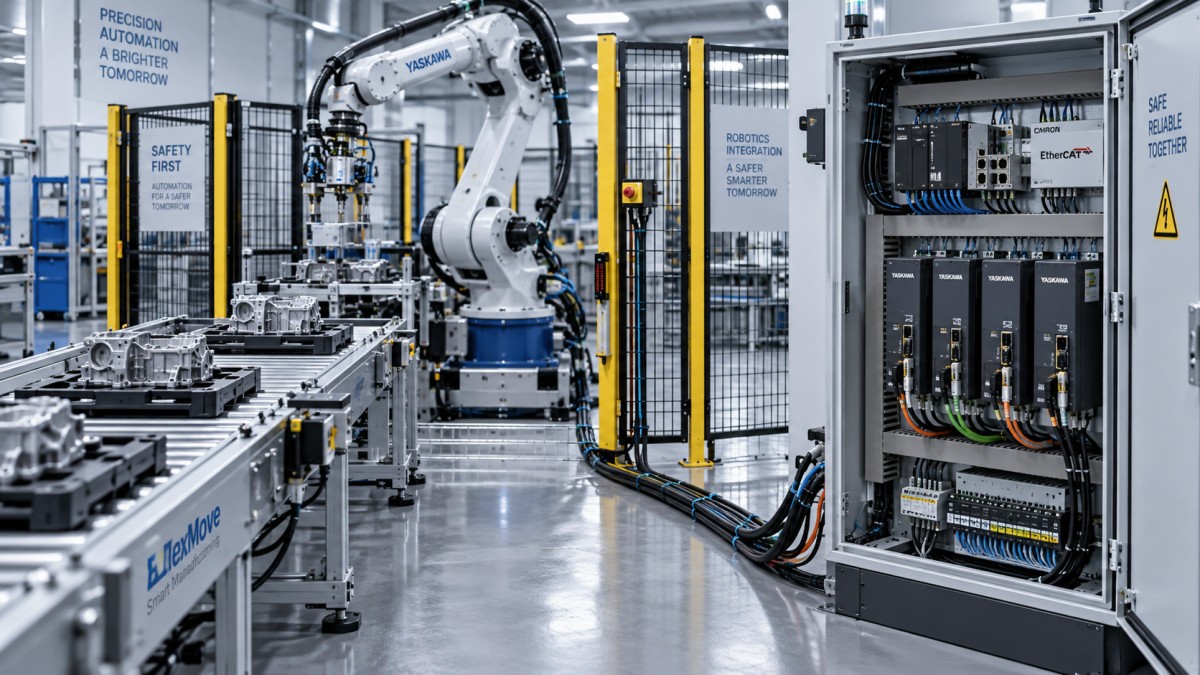
What does a safety claim actually establish?
A safety-rated feature on a controller does not establish the safety of the complete robot cell. Protective devices, wiring, end effectors, fixtures, operating modes, and access arrangements all affect the result. The evidence must identify the supplied configuration and the safety functions being used.
Request documentation for the relevant functions, including their limitations and integration requirements. Safe torque off, for example, removes the drive’s ability to generate torque; it does not by itself guarantee a controlled stop or prevent gravity-driven movement. Where a vertical axis or suspended load creates a hazard, braking and load retention require separate consideration.
Stopping behavior also depends on speed, payload, tooling, robot posture, and the selected stop function. A generic stopping-time figure should not become the sole basis for protective separation. Validation must address the actual application and the conditions that produce the relevant stopping behavior.
Mixed-vendor installations introduce a further boundary: ordinary network status signals are not automatically suitable for safety communication. If safety functions cross controller boundaries, document the supported safety connection, fault response, and reset arrangement. An emergency-stop reset must not itself initiate hazardous motion.
Is a successful demonstration enough to confirm performance?
A demonstration proves little when it uses a lighter payload, simpler path, or fewer simultaneous tasks than the intended process. Controller performance must be assessed with the robot, tooling, workpiece, and production sequence that determine the real demand.
Axis count is particularly easy to misread. Support for additional axes may mean independent positioning rather than coordinated movement with the robot. A positioner used during welding, for example, requires a different level of coordination from a conveyor that advances only while the robot is stationary. Confirm which motion groups are available and which options enable the required behavior.
Path accuracy, robot repeatability, and cycle time describe different things. A robot can repeatedly reach taught points while failing to maintain the required speed or tool orientation between them. Continuous-path applications therefore need evaluation of blending, acceleration limits, singularity handling, and external-axis coordination.
Use an acceptance cycle that includes communication traffic, process commands, data recording, and representative fault recovery. Set measurable limits around the process requirement. Avoid judging controller performance from a processor specification or an unloaded motion sequence.
Software options can turn similar quotations into different systems
Controller quotations often separate the base hardware from the functions needed to operate it. Network interfaces, offline programming, application packages, external-axis control, safety options, and remote diagnostics may carry separate licenses. A low initial price loses meaning when required functions appear only after the order is placed.
Compare complete configurations using a common bill of materials. The quotation should identify installed options, license duration, transfer restrictions, and the software versions needed to maintain the system. Clarify whether engineering tools require subscriptions and whether a replacement controller needs license reactivation.
Programming portability deserves its own review. Similar command names do not make programs interchangeable across vendors. Coordinate frames, tool definitions, motion instructions, recovery routines, and application interfaces differ. A common supervisory interface can standardize commands such as “run job” or “report fault,” while the motion program remains specific to each robot system.
Access to source files also matters. Define the delivery of editable programs, configuration files, interface documentation, and credentials needed for authorized maintenance. A system that runs correctly but cannot be modified without the original integrator creates a dependency that should be visible in the sourcing decision.
Why do controller comparisons miss installation costs?
A controller can meet functional requirements and still arrive in a form that does not fit the installation. Supply voltage, electrical protection, cabinet dimensions, cooling requirements, environmental rating, and cable routing all influence the work needed before commissioning.
Consider the controller cabinet separately from the robot arm. An arm suited to a dusty or wet process does not establish that its controller can occupy the same environment. Ambient temperature, conductive dust, ventilation clearance, and heat from nearby equipment affect enclosure placement and cooling design.
Cable length is another practical constraint. Robot, feedback, pendant, and external-axis cables have supported types and length limits. Unapproved extensions can introduce signal problems or invalidate the intended configuration. Establish the cabinet location and routing early enough to specify the correct cable package.
A useful cost comparison separates one-time integration expenses from recurring ownership costs. Include engineering tools, spare components, support arrangements, cooling maintenance, and license renewal where applicable. Training costs also rise when different controllers use different fault recovery and programming procedures. These differences belong in the comparison without assuming that one vendor is always cheaper over the system’s life.
Recovery capability is often left out of acceptance testing
Normal operation is only part of controller suitability. Power interruptions, communication failures, interrupted process steps, and component replacement expose differences that routine demonstrations rarely reveal.
Specify recovery scenarios before acceptance:
- Loss of the supervisory connection: establish whether motion stops, a defined cycle completes, or another approved response occurs. Reconnection must not silently replay a stale start command.
- A power interruption during a process step should leave an identifiable job state. Recovery may require verifying the workpiece position or process condition before motion resumes.
- Controller replacement should be demonstrated through a documented restore procedure, including software compatibility, license activation, and any required calibration.
A backup is useful only when its contents and restoration conditions are understood. Depending on the controller architecture, a complete recovery package can include robot programs, system settings, calibration data, safety configuration, network settings, and licensed options. An exported program folder alone may leave substantial commissioning work unresolved.
Record the accepted firmware and software versions. Updates can affect option compatibility or interface behavior, so the support arrangement should identify how changes are assessed and how an unsuccessful update is recovered.
Remote access and support need concrete boundaries
Remote diagnostics can reduce troubleshooting delays, but an unmanaged connection creates an additional route into the automation system. Establish how access is authenticated, enabled, logged, and withdrawn. Determine whether remote service depends on an external service, whether outbound connections are required, and which functions remain available when that connection is unavailable.
Support promises also need operational detail. “Global support” does not establish local availability of a replacement board, qualified service, or access to the required engineering software. Ask which controller components are replaceable, how spares are identified, and what happens when the installed hardware or software reaches the end of support.
For refurbished or previously installed controllers, confirm provenance, hardware revision, license status, and compatibility with the intended robot. Missing calibration records, undocumented modifications, or unavailable options can outweigh an attractive purchase price.
Who owns faults between vendors?
Leaving interface responsibility unresolved is a frequent source of commissioning delays. A robot controller, cell control system, vision device, and process tool can each pass separate tests while the combined sequence still fails. The contract should name the party responsible for demonstrating the complete sequence and resolving failures at those boundaries.
Acceptance evidence should connect the delivered configuration to the agreed application: actual hardware and software versions, successful production sequences, fault responses, recovery procedures, and complete restoration files. Separate tests remain useful, but they do not replace an integrated test under representative conditions.
Close unresolved deviations before final acceptance. Each deviation needs a defined operational consequence, an owner, and a completion condition. That prevents a controller with unfinished integration work from being treated as a fully commissioned system.
Related Industries
- What Should You Check When Buying Rice Milling Machines Wholesale?Buying rice milling machines wholesale? Learn how to verify capacity, rice recovery, operating costs, and supplier support to avoid costly mistakes and buy with confidence.
- Oct. 28 Rare Earth Magnet Index Eases as Pr-Nd Oxide Softens, Dysprosium Oxide RisesRare Earth Magnet Index fell 0.24% on Oct. 28, 2026, as Pr-Nd oxide softened and dysprosium oxide rose. Explore what diverging prices mean for magnet procurement and supplier quotes.
- Which Safety Standards Apply to Autonomous Harvesters in the Field?Explore autonomous harvester safety standards, including ISO 18497, ISO 25119, and ISO 4254. Learn what evidence to demand before approving safe field operations.
Weekly Insights
Stay ahead with our curated technology reports delivered every Monday.
Related Industries
Recommended News
- 00
0000-00
How Do You Choose Robot Controllers for High-Precision Assembly Lines?How to pick robotic controllers for high-precision assembly lines: compare motion, sensing, safety, and lifecycle costs. Explore the guide to improve assembly quality at production speed.By Dr. Victor GearOct 26, 2026 - 00
0000-00
How to Use an Automation Sourcing Reference Guide to Compare RobotsUse an automation sourcing reference guide to compare robots on performance, safety, and lifecycle costs. Uncover hidden costs and choose the right system with confidence.By Dr. Victor GearOct 25, 2026 - 00
0000-00
How to Choose a Robotic Gripper Manufacturer for Your ApplicationChoose a robotic gripper manufacturer with confidence. Learn how to evaluate gripping performance, integration, testing, and lifecycle costs to find the right fit for your application.By Dr. Victor GearOct 17, 2026
0000-00
