
Global Energy & Strategic Industrial (G-ESI)
What discharge pressure should an H2 compression system meet?
What Discharge Pressure Should an H2 Compression System Meet?
Determining the required discharge pressure for an H2 compression system is a critical engineering decision affecting storage capacity, transport compatibility, safety compliance, and project economics.
For technical evaluators, the correct target depends on hydrogen end use, applicable ISO, ASME, and local regulations, compressor configuration, and downstream equipment limits.
The practical answer is not one universal pressure value. An H2 compression system should meet the highest verified downstream pressure requirement, including margin for losses, filling dynamics, and operating degradation.
Most projects fall into recognizable pressure bands. These range from roughly 20 to 50 bar for low-pressure process supply to 350, 700, or 1,000 bar for mobility applications.
However, specifying only a nominal discharge pressure is incomplete. Technical evaluators must also confirm guaranteed flow, gas temperature, purity protection, pressure stability, availability, and safe relief design.
Start With the Final Hydrogen Use Case
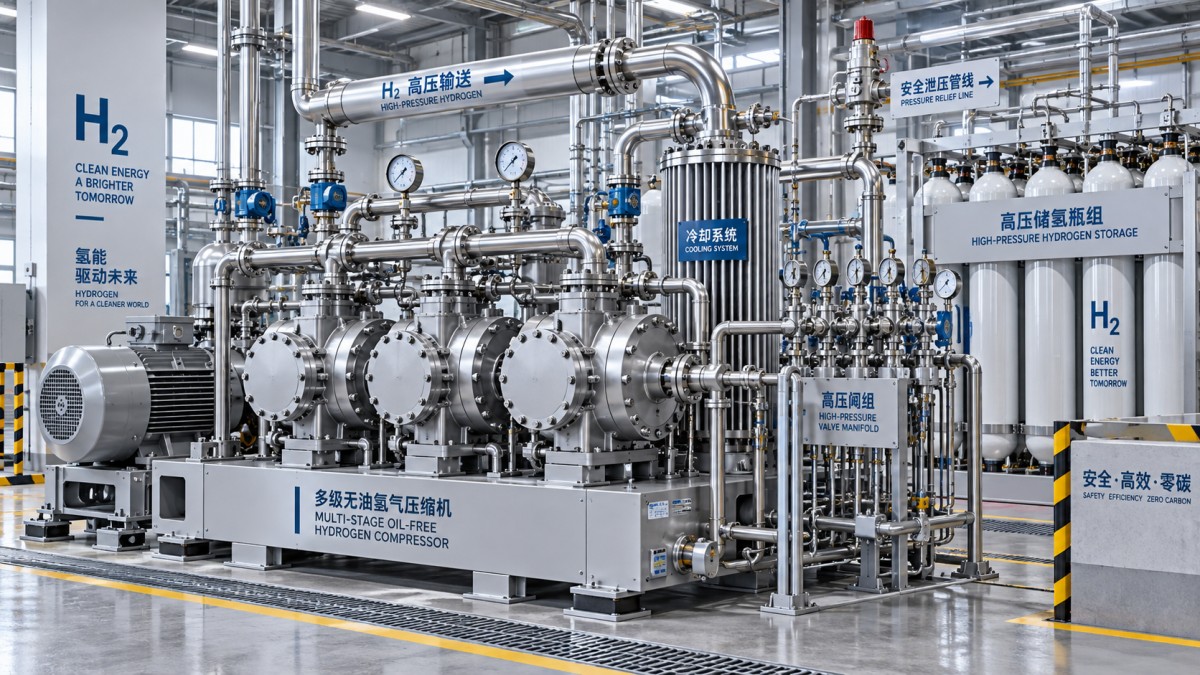
The final use case should establish the discharge-pressure requirement before compressor vendors are compared. Storage vessels, transport interfaces, dispensers, reactors, and pipelines each impose different pressure boundaries.
For low-pressure industrial consumption, an H2 compression package may only need to discharge between 20 and 50 bar. Typical examples include burner supply, laboratory networks, and selected chemical processes.
Projects serving refinery hydrotreating, ammonia synthesis, methanol production, or other process units may require substantially higher pressure. The actual target depends on reactor conditions and feed-system pressure losses.
Hydrogen pipeline injection commonly operates within a broad range, often from approximately 30 to 100 bar. The required discharge pressure must exceed the pipeline’s maximum operating pressure.
Tube trailer filling is frequently designed around 200, 250, 300, or 500 bar, depending on regional equipment practices. Filling pressure must account for cascade utilization and final trailer pressure.
Hydrogen refueling stations are usually associated with 450-bar storage systems for 350-bar vehicle fueling. For 700-bar vehicle fueling, station storage commonly reaches 875 to 1,000 bar.
Electrolyzer projects need special attention because stack outlet pressure does not automatically define compressor discharge pressure. Buffer storage, purification, transport, and end-user conditions may alter the requirement.
Technical evaluators should document the final delivery point clearly. A compressor specified to discharge at 450 bar may be inadequate when downstream pressure losses prevent full 350-bar vehicle fills.
Pressure should therefore be defined at the contractual battery limit. State whether the guarantee applies at compressor discharge, storage inlet, dispenser inlet, trailer connection, or customer delivery flange.
Use Pressure Bands as Screening Criteria, Not Final Specifications
Pressure bands help screen technology options, but they do not replace a system calculation. The relevant design pressure must reflect normal operation, maximum operation, upset cases, and protection settings.
Low-pressure hydrogen compression below 50 bar may favor simpler configurations, but materials compatibility, leak containment, and seal performance still remain essential engineering concerns.
Medium-pressure applications between 50 and 250 bar are common in industrial storage, blending, and logistics. Reciprocating compressors are often considered because of their established operating experience.
High-pressure duty from 250 to 550 bar typically requires closer evaluation of compression stages, intercooling, pulsation control, leakage management, and maintenance access.
Very high-pressure H2 compression above 700 bar presents additional thermodynamic and mechanical challenges. These systems require rigorous evaluation of temperature rise, fatigue life, and contamination control.
A useful screening rule is to select a nominal discharge pressure approximately 10 to 20 percent above the required downstream operating pressure. This is only a preliminary estimate.
The appropriate margin varies with piping losses, storage filling profile, ambient temperature, compressor turndown, and allowed performance degradation. It should be justified through a documented pressure balance.
Excessive margin can increase capital cost, energy consumption, heat rejection duty, and component stress. Too little margin can leave storage partially filled or prevent reliable downstream operation.
For this reason, technical specifications should distinguish nominal discharge pressure from maximum allowable working pressure, design pressure, relief-set pressure, and hydrotest pressure.
Calculate the Required Pressure at the Actual Operating Boundary
A reliable H2 compression specification begins with a pressure profile covering the entire path from hydrogen source to final consumption point. Each component creates a pressure requirement or loss.
Start with the minimum required pressure at the delivery point. Then add pressure losses through piping, valves, filters, dryers, purification equipment, meters, hoses, and control devices.
Next, account for storage behavior. Filling a high-pressure vessel requires compressor discharge pressure above the vessel’s instantaneous pressure, not merely above its average operating pressure.
For cascade systems, the compressor must support the intended cascade sequence. Otherwise, the highest storage bank may not reach its target pressure during peak demand periods.
Pressure losses can increase as flow rises. Evaluators should calculate both steady-state and peak-flow cases, especially where rapid filling, batch processing, or intermittent demand is expected.
Filter differential pressure deserves explicit treatment. A clean filter may impose a modest loss, while an end-of-life element can materially reduce downstream pressure availability.
Dryers and purifiers also require careful review. Some purification technologies have defined inlet-pressure ranges, differential-pressure limits, and pressure-drop characteristics that affect compressor sizing.
Temperature affects pressure readings and storage capacity. A pressure target measured at elevated gas temperature may fall materially after cooling, potentially reducing usable stored hydrogen.
For mobility projects, account for fueling protocols and pre-cooling requirements. The compression train must integrate with storage and dispensing equipment without exceeding equipment pressure or temperature limits.
The final calculation should identify the minimum compressor discharge pressure needed under the worst credible operating condition. This is more useful than relying on nameplate pressure alone.
Separate Normal Operating Pressure From Mechanical Design Limits
Confusion between operating pressure and equipment design pressure is a recurring source of specification errors. These values serve different purposes and should never be used interchangeably.
Normal operating pressure is the expected pressure during stable production. It should support required throughput while remaining within the preferred efficiency and reliability range of the H2 compression system.
Maximum operating pressure reflects the highest anticipated condition during normal control actions, including storage topping, flow fluctuations, startup, and temporary demand changes.
Design pressure is the mechanical basis for vessels, piping, fittings, valves, and compressor pressure-containing parts. It must consider credible excursions and applicable code requirements.
Maximum allowable working pressure, often abbreviated MAWP, is a verified equipment limit. It may differ from design pressure because of fabrication details, corrosion allowance, or component ratings.
Relief valves must be set to protect the lowest-rated protected component. Their discharge paths must safely manage hydrogen release, ignition risk, accumulation, and applicable separation distances.
When a compressor is connected to storage, evaluate blocked-discharge scenarios. A closed valve, failed controller, or downstream isolation event can rapidly raise pressure in confined sections.
Isolation valves should not create trapped volumes without thermal-relief protection. Hydrogen temperature changes can increase pressure in blocked liquid-free gas sections, particularly at high initial pressures.
Specifications should identify each pressure basis in a data sheet. This improves vendor comparability and prevents a proposal from appearing compliant while omitting critical overpressure requirements.
Verify Standards, Material Compatibility, and Safety Controls
Applicable codes depend on project location, equipment classification, and contract requirements. Common reference frameworks include ASME pressure-vessel rules, ISO standards, API practices, and local regulations.
ASME Section VIII is frequently relevant for pressure vessels, while ASME B31.12 is often considered for hydrogen piping and pipelines. Jurisdictional requirements remain decisive.
ISO standards may apply to hydrogen fuel quality, refueling interfaces, storage systems, and safety practices. The relevant edition and project-specific adoption status should be confirmed early.
Pressure rating alone does not establish hydrogen suitability. High-pressure hydrogen can worsen fatigue, permeation, leakage, and embrittlement risks in unsuitable metallic materials and components.
Material selection should consider hydrogen partial pressure, gas purity, pressure cycling, minimum metal temperature, tensile strength, hardness, weld quality, and anticipated inspection regime.
For seals and packings, assess compatibility with dry hydrogen, trace contaminants, temperature range, and cycling duty. Seal degradation can affect emissions, availability, and gas purity.
Hydrogen detection should cover credible leak locations, including compressor enclosures, seal vents, valve manifolds, storage connections, and enclosed cable or utility spaces.
Ventilation, classified electrical equipment, emergency shutdown logic, and vent-stack design require coordinated review. These measures should be evaluated as an integrated safety system rather than isolated components.
Functional safety review should include overspeed, high discharge temperature, high vibration, low lubrication, gas detection, high pressure, and cooling-system failure conditions.
Assess Compressor Performance Beyond the Discharge-Pressure Number
A vendor’s stated maximum discharge pressure is not enough to establish suitability. The evaluation must confirm guaranteed flow at the required suction conditions, discharge pressure, and ambient conditions.
Hydrogen flow should be expressed consistently, preferably using defined reference conditions. Confusion between normal cubic meters, standard cubic meters, and actual volumetric flow can distort comparisons.
Compression ratio strongly influences stage count, power demand, discharge temperature, and reliability. A large ratio may be technically possible but economically unattractive or operationally restrictive.
Interstage cooling reduces gas temperature and compression power. Evaluators should request guaranteed intercooler outlet temperatures, cooling utility conditions, pressure drops, and fouling assumptions.
High discharge temperatures can affect seals, valves, lubricants, and downstream purification systems. Vendor guarantees should specify maximum continuous temperatures and alarm or trip thresholds.
Oil-free compression may be required where fuel-cell-grade hydrogen or sensitive downstream catalysts are involved. The complete system must still be assessed for contamination sources.
Availability guarantees should distinguish scheduled maintenance, unplanned outages, and utility-related downtime. A high-pressure machine with frequent seal replacement may not meet project production targets.
Turndown capability matters where hydrogen production or demand varies. Evaluate whether the compressor can operate efficiently and safely at reduced flow without excessive recycle or cycling.
Noise, vibration, footprint, lifting access, spare-parts lead time, and remote monitoring are secondary to pressure performance, yet they materially affect lifecycle value and maintainability.
Build a Procurement Specification That Can Be Tested
The procurement document should state a guaranteed operating point, not only a maximum rating. Define suction pressure, suction temperature, gas composition, flow rate, discharge pressure, and utility conditions.
Specify whether the discharge-pressure guarantee applies continuously, at rated flow, at maximum ambient temperature, and after defined operating hours. These details close common commercial gaps.
Require a compressor curve or performance map showing flow, power, discharge temperature, and efficiency across expected suction and discharge conditions. This supports realistic operational planning.
The vendor should identify all pressure-containing components and their ratings. This includes cylinders, coolers, separators, piping, fittings, valves, instruments, hoses, and storage interfaces.
Factory acceptance testing should verify pressure, flow, temperature, vibration, controls, leak performance, and safety shutdowns. Test gas, test duration, and acceptance tolerances should be agreed.
Site acceptance testing should confirm integrated operation with actual downstream equipment. A compressor can pass factory tests yet fail to achieve required pressure after installation losses are introduced.
Specify documentation requirements including P&IDs, pressure-relief calculations, hazardous-area classification, material certificates, inspection records, operating manuals, and preventive-maintenance schedules.
For critical assets, require lifecycle support commitments. These should address spare parts, response time, remote diagnostics, overhaul intervals, training, and performance troubleshooting responsibilities.
Technical evaluators should use a weighted comparison matrix. Pressure compliance should carry substantial weight, but energy use, reliability, safety evidence, and service capability should also influence selection.
Conclusion: Set Pressure From the System Requirement, Then Prove It
An H2 compression system should meet the pressure required at the downstream delivery boundary under the most demanding credible operating condition, with properly calculated losses and operating margin.
Typical targets may range from below 50 bar for industrial supply to 1,000 bar for high-pressure refueling infrastructure. The application, however, determines the correct value.
Technical evaluators should avoid selecting equipment solely because its nameplate maximum exceeds a familiar pressure threshold. A valid selection requires a complete pressure, flow, temperature, and safety review.
The strongest procurement decision is supported by a documented pressure balance, clearly separated pressure definitions, verified code compliance, realistic performance guarantees, and testable acceptance criteria.
By treating discharge pressure as a system-level engineering requirement rather than a single compressor rating, project teams can reduce underperformance risk and improve long-term hydrogen asset reliability.
Related Industries
- What Hydrogen Transport News Reveals About Infrastructure InvestmentDiscover what hydrogen transport news reveals about infrastructure investment. Assess demand, delivery costs, and project risks to identify opportunities worth pursuing.
- Megawatt-Scale PEM Electrolyzer Completes Grid Connection Testing in NorwayMegawatt-scale PEM electrolyzer completes grid connection testing in Norway. Explore reported dynamic-load performance and key checks for green hydrogen procurement.
- How to Choose a Beryllium Copper Rod for Strength and ConductivityChoose the right beryllium copper rod for strength and conductivity. Compare alloy grades, tempers, ASTM standards, and supplier certificates to make a confident purchasing decision.
Weekly Insights
Stay ahead with our curated technology reports delivered every Monday.
Related Industries
Recommended News
- 00
0000-00
What Hydrogen Transport News Reveals About Infrastructure InvestmentDiscover what hydrogen transport news reveals about infrastructure investment. Assess demand, delivery costs, and project risks to identify opportunities worth pursuing.By Dr. Julian VoltOct 14, 2026 - 00
0000-00
What discharge pressure should an H2 compression system meet?H2 compression discharge pressure guide: match end-use needs, pressure losses, safety codes, and performance margins for reliable hydrogen delivery.By Dr. Julian VoltOct 09, 2026 - 00
0000-00
What safety risks must be managed when compressing hydrogen?Compressing hydrogen safely demands strict control of leaks, ignition sources, high pressure, materials, venting, and maintenance. Explore key risks and proven safeguards.By Dr. Julian VoltOct 09, 2026
0000-00
