Global Energy & Strategic Industrial (G-ESI)
Reducing Downtime Risks When Procuring Poultry Slaughterhouse Equipment
Downtime begins long before the line stops
When a slaughter line is unavailable, the immediate loss is rarely limited to missed processing hours. Live-bird arrival schedules may be disrupted, chilling capacity can be underused, labor may be reassigned or left waiting, and downstream packaging commitments can become harder to meet. For procurement teams, the practical question is not simply whether a machine meets its stated capacity. It is whether the complete system can be installed, operated, cleaned, serviced, and restarted without creating recurring interruptions.
Downtime risk is often introduced during specification rather than operation. A conveyor may be correctly sized in isolation but poorly matched to shackling, scalding, evisceration, chilling, or packing throughput. A supplier may provide sound equipment but insufficient drawings, spare-parts visibility, electrical documentation, or commissioning support. In a wet, high-cleaning environment, a minor weakness in drainage, access panels, sensor protection, or material finish can later become a maintenance issue.
Procurement decisions should therefore treat availability as a system-level requirement. The objective is to identify where an equipment failure, sanitation delay, missing component, or installation mismatch could halt the line—and to reduce those exposure points before issuing an order.
Define the operating envelope before comparing quotations
Many procurement documents begin with target output, bird type, and available floor area. Those are necessary inputs, but they do not fully describe the operating envelope. A more useful specification explains what the line will experience during a normal shift and during less ideal conditions.
For example, line speed should be considered alongside bird-weight range, flock uniformity, expected arrival pattern, staffing level, utility stability, cleaning frequency, and the intended number of operating hours between scheduled maintenance windows. Equipment selected around an optimistic average may become unstable when bird size changes, water pressure drops, or upstream handling varies. A line does not need to fail completely to create downtime; repeated speed reductions and manual interventions can have much the same commercial effect.
Purchasers can ask operating teams to document the following before supplier discussions become too detailed:
- Expected birds per hour and the practical maximum speed, rather than a single headline capacity.
- Bird type, live weight range, and the degree of variation expected across deliveries.
- Shift pattern, cleaning regime, and time available for planned maintenance.
- Available electrical supply, water quality and pressure, drainage layout, compressed air, refrigeration interfaces, and wastewater constraints.
- Building limitations such as column locations, ceiling height, floor loading, access doors, and the route for bringing large modules into place.
- Required handoff points between live receiving, slaughter, evisceration, chilling, cut-up, packing, and cold storage.
These details help distinguish a line that can theoretically process a certain volume from one that can do so reliably within the buyer’s actual facility. They also prevent suppliers from pricing different assumptions under apparently comparable offers.
Capacity matching is a balance problem, not a nameplate exercise
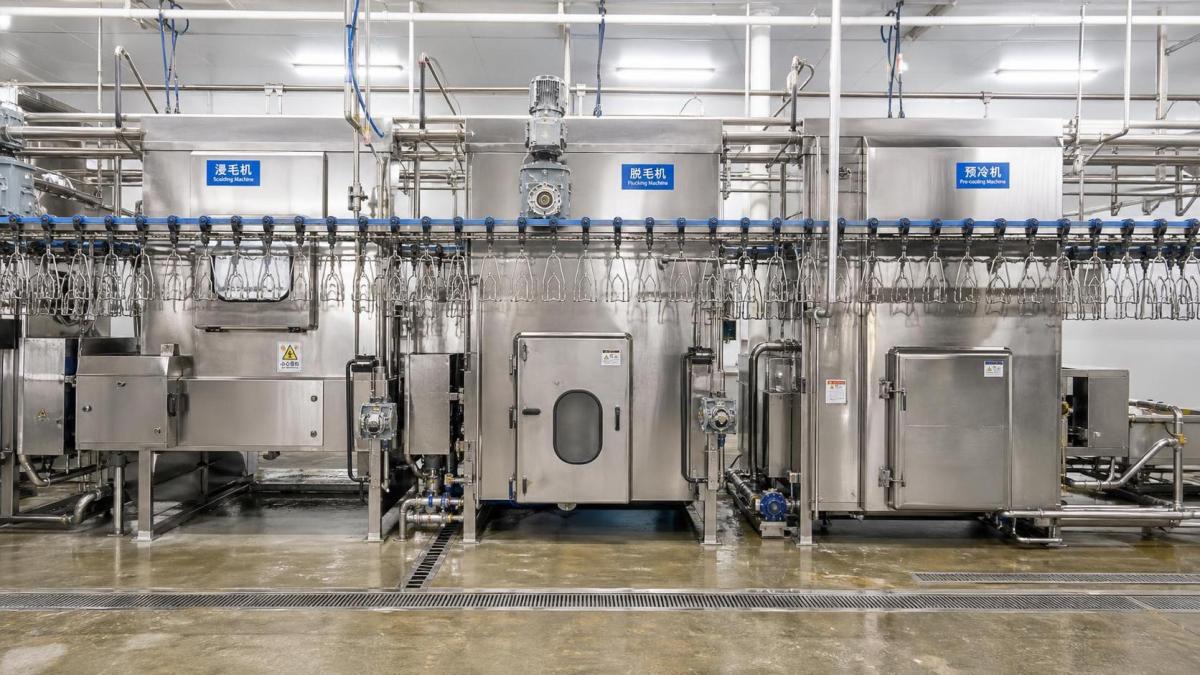
Every processing line has constraints. The slowest or most interruption-prone stage generally determines usable output, particularly where there is little buffer capacity between operations. Increasing conveyor speed without checking scalding dwell time, plucker performance, inspection arrangements, chilling residence time, and packing capability may transfer the bottleneck rather than remove it.
Procurement teams should map the intended process sequence and identify the designed rate at each transfer point. The review should include normal operating speed, reduced-speed operation, and recovery after a short stop. A line that restarts smoothly after a jam or brief utility interruption can be easier to manage than a higher-rated arrangement with sensitive synchronization requirements.
Buffering deserves particular attention. Limited accumulation may be appropriate at selected points, but it also creates sanitation, control, and product-flow considerations. The right amount depends on process design and applicable hygiene requirements. The important procurement discipline is to ask where a stop will propagate and how the line is expected to recover. This is especially relevant where a single shackle conveyor links several stages or where a downstream machine requires a consistent product presentation.
Specify maintainability as carefully as throughput
Mechanical reliability is only one part of availability. Equipment that is dependable but difficult to inspect, clean, adjust, or repair can still produce excessive downtime. Maintainability should appear as a defined evaluation category rather than an informal impression formed during a factory visit or proposal review.
For wet-process equipment, buyers should examine accessible bearings, chain tensioning arrangements, guarded drive systems, lubrication points, removable covers, drainability, and access around motors and gearboxes. There should be enough physical space for technicians to remove components without dismantling adjacent equipment or working in unsafe positions. Fasteners, seals, scrapers, belts, guides, nozzles, and sensors should be identifiable in drawings and parts lists.
Material selection must also be assessed in relation to cleaning chemicals, moisture exposure, and contact with organic matter. Stainless construction alone does not answer every question. Crevices, rough welds, poorly sloped surfaces, trapped water, incompatible seal materials, and hard-to-reach frames can lead to corrosion, hygiene concerns, or extended washdown time. Purchasers should request clarity on the material grades and finishes used in different zones instead of assuming that all visible metal has the same characteristics.
A practical equipment-planning resource for poultry slaughterhouse equipment can help procurement teams frame the line as connected processing stages rather than a collection of individual machines. That perspective is useful when reviewing interfaces, utility requirements, access needs, and the operational consequences of a stoppage at any one stage.
Review control architecture and utility dependency
Controls can be a major source of avoidable delay when they are poorly documented or overly dependent on proprietary access. Procurement teams do not need to prescribe every programming detail, but they should understand the control boundary: which equipment is governed by which panel, how upstream and downstream interlocks behave, and what happens after an emergency stop or loss of power.
Questions worth documenting include whether operators can see fault messages at the relevant location, whether alarms distinguish between a process condition and an equipment fault, and whether authorized site personnel can access routine settings. Clear wiring diagrams, panel layouts, input/output lists, and software backup arrangements reduce the time required to diagnose a problem later. Where remote support may be used, cybersecurity practices, access permissions, connectivity limitations, and response expectations should be agreed in advance.
Utility assumptions deserve equal scrutiny. Water-fed systems depend on stable pressure and filtration appropriate to their design. Pneumatic actuators may respond poorly if air quality or pressure is inconsistent. Motors, variable-speed drives, and control panels need suitable power conditions and environmental protection. If refrigeration, hot-water, wastewater, or ventilation systems are supplied by other contractors, responsibility for their interfaces should be explicit. An otherwise sound purchase can be delayed at commissioning because no party owns a missing cable, pipe connection, drain, or communication signal.
Turn supplier evaluation into evidence-based risk review
Price comparisons become misleading when proposals differ in scope, commissioning responsibilities, excluded items, and post-delivery support. A lower capital quotation may leave the buyer responsible for engineering work, installation tooling, spare parts, integration programming, or site modifications that another proposal includes. The remedy is not necessarily a longer tender; it is a more structured comparison.
Evidence should match the risk being assessed. If hygienic construction is central to the project, ask for drawings that show drains, access points, surfaces, and cleaning access. If rapid parts availability is essential, request a recommended start-up spare-parts list and confirm part identification methods. If delivery timing is sensitive, separate the dates for design approval, fabrication, shipment, installation readiness, and commissioning. A single “delivery date” often conceals several dependencies.
Plan spares around consequence, not only purchase value
A critical spare is not always an expensive component. A low-cost sensor, seal, chain link, nozzle, belt, relay, or specialized fastener can stop a line if it is unavailable locally. Conversely, stocking every possible component ties up capital and may create expiry or storage problems. The starting point should be failure consequence: would the part stop production, reduce product control, create a safety concern, or force a lengthy manual workaround?
Procurement teams can categorize items into start-up spares, routine consumables, planned replacement parts, and long-lead contingency items. The supplier’s recommended list should be challenged constructively against local service capability and import lead times. Parts that require matching software, calibration, or special tools also need attention. A component is not truly available if the site cannot install or configure it.
Storage conditions matter as well. Electronic components, elastomers, lubricants, and certain belts may have environmental or shelf-life limitations. The maintenance plan should state who reviews stocked inventory, how part numbers are kept current after design changes, and how obsolete parts are managed.
Use acceptance criteria that reflect real operating conditions
Factory inspection and site acceptance are valuable, but they answer different questions. A factory review can confirm fabrication quality, major dimensions, component identification, guarding, and basic mechanical operation before shipment. Site acceptance addresses installation quality, utility performance, control integration, drainage, operator access, and actual process flow.
Acceptance criteria should avoid vague wording such as “operates satisfactorily.” Better criteria describe the agreed process sequence, safety interlocks, documentation handover, training completion, and test conditions. Where performance depends on live production conditions, the parties can define a reasonable commissioning period and a method for recording faults, adjustments, and unresolved issues. Buyers should also clarify whether temporary workarounds count as acceptance or whether they must be replaced by a permanent correction.
Commissioning schedules frequently underestimate the time needed for dry runs, washdown checks, sensor adjustments, operator familiarization, and coordination with utilities. Rushing this period may shift unresolved issues into commercial production, when each interruption is more costly and harder to investigate.
Reduce risk through ownership after handover
The handover package should allow the site to operate without relying on memory or informal messages. It normally needs approved drawings, manuals, maintenance schedules, spare-parts references, electrical information, cleaning instructions, control backups where applicable, and a record of outstanding actions. Internal ownership should also be clear: production may own routine observations, maintenance may own planned inspections, sanitation teams may identify cleaning-access concerns, and procurement may retain responsibility for supply continuity and warranty follow-up.
The strongest procurement outcome is not the lowest equipment price or the highest stated speed. It is a line whose assumptions have been tested against the site, whose failure points are visible, and whose recovery path is understood before production pressure begins. When purchasing teams evaluate poultry slaughterhouse equipment through that lens, downtime becomes a manageable design and supply-chain risk rather than an expensive surprise after installation.
Related Industries
- Which EPA Regulations Apply to Methane Emissions at LNG Facilities?Which EPA Regulations apply to methane emissions at LNG facilities? Explore reporting rules, permit requirements, and equipment standards to clarify your compliance obligations.
- How Do You Choose Wholesale UV Absorbers for Tractor Coatings?Choose wholesale UV absorbers for tractor coatings with confidence. Learn how to verify compatibility, compare weathering data, and evaluate true costs before placing bulk orders.
- What Hydrogen Transport News Reveals About Infrastructure InvestmentDiscover what hydrogen transport news reveals about infrastructure investment. Assess demand, delivery costs, and project risks to identify opportunities worth pursuing.
Weekly Insights
Stay ahead with our curated technology reports delivered every Monday.
Related Industries
Recommended News
- 00
0000-00
Planning Poultry Equipment for a Nigeria Farm Business PlanPoultry equipment in Nigeria business plan guide: match systems to farm goals, utilities, biosecurity, and budget for resilient growth.By Elena HarvestOct 09, 2026 - 00
0000-00
How Pea Protein Isolate Powder Supports Sustainable Food FormulationPea protein isolate powder supports sustainable food formulation through efficient performance, resilient sourcing, and plant-based innovation. Explore key evaluation factors.By Elena HarvestOct 02, 2026 - 00
0000-00
Battery Cage System Design Factors That Influence Layer Welfare and OutputCage system design directly affects layer welfare, egg quality, and output. Explore key factors in space, feeding, ventilation, manure control, and automation.By Elena HarvestSep 22, 2026
0000-00
